Famine in Oleshky. Nearly 1,700 Ukrainians, including 47 children, are starving in the besieged town
Tetiana Hasanenko, Head of the Oleshky Military Administration, on the russian siege of Oleshky, which could become yet another horrific russian crime
By Dmytro Syniak
Hard to believe, impossible to imagine, but unfortunately it is a fact: there is famine in the occupied town of Oleshky. In the once cosy and prosperous satellite town of Kherson, with a population of 24,000, people are dying – from starvation, disease, russian mines and drones. Journalist Mariia Semenchenko recently published excerpts from a diary written by her aunt, who remained in Oleshky community under occupation. With Maria’s permission, we are publishing excerpts from this diary here. Meanwhile, Tetiana Hsanenko, Head of the Oleshky Military Administration, shared with Decentralisation what is currently happening in Oleshky.
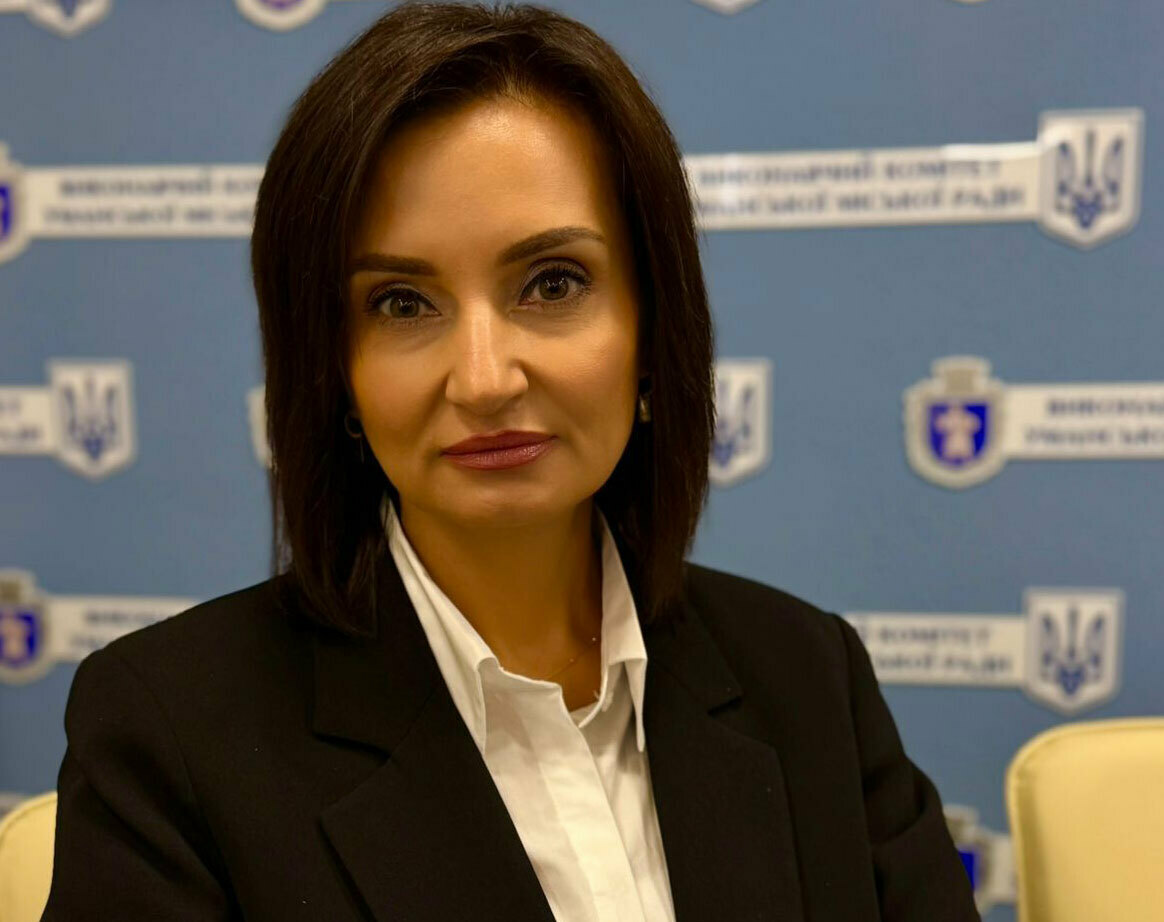
Tetiana Hsanenko, Head of the Oleshky Military Administration
Siege
What can you share about the situation in Oleshky? Is there really a famine there? How did this come about?
After the russians destroyed the Antonivskyi Bridge in November, which connects Oleshky to Kherson, they have been continuously laying mines across our community’s territory. Later, fearing a Ukrainian offensive, they began mining the roads as well. Then vehicles carrying food, medicines, and other essential supplies started blowing up on their mines. As a result, these vehicles stopped travelling.
What is the point of mining roads and endangering the lives of civilians? After all, the russians consider this territory to be theirs…
I cannot comment on military matters, nor can I explain the behaviour of the russians. I can only say that whilst they used to have several checkpoints on the road to Oleshky, there are now none. Instead, the whole area is heavily mined. And russian drones are constantly lurking in the sky. Their operators are killing people, it seems to me, simply out of boredom. Therefore, no one prohibits entering or leaving the town anymore, but it is usually a one-way trip. Even if a person is merely wounded, they are destined to die, because no ambulance will come to their aid if their car hits a mine or is attacked by a drone. There are simply no ambulances.
When did Oleshky fall under complete siege?
After the Antonivskyi Bridge was destroyed, Oleshky was left on the front line. The collaborationist authorities then fled the town, and as a result, the provision of almost all services ceased. If someone wanted to cash out their card, go to the local council or the pension fund – they had to travel to Skadovsk, nearly 80 km away!.. And people did travel. But the unmined areas were shrinking week by week. Until February 2026, the occasional car still managed to bring in the most essential supplies. But by the end of February, the situation had become unbearable: leaving the town had turned into a death trap. That was when the real famine began.
Does this mean that no vehicles carrying food can reach the community at all? At least the russian troops in the town must be getting their food somehow. So, there must be some sort of transport link after all…
Over the last twenty days, the number of vehicles that have managed to make their way to Oleshky through the minefields can be counted on the fingers of one hand. However, there is another piece of data. On 15 April, two vehicles were blown up by mines: one was carrying liquefied gas into the town, the other food supplies. On the same day, a car carrying people trying to leave was blown up by a mine. The driver was injured in the incident. So we can say that the supply of food or any essential goods to Oleshky has stopped.
‘20 January 2026
…when snow fell on 10 January, bread and groceries were no longer delivered to the town. Only a small amount was brought to “Katiusha” once – on 18 January. The bread was sold out as soon as it was unloaded. There was a long queue for groceries, and everything ran out quickly. After that, “Katiusha” didn’t open again. And “Ovochevyi” and “Romashka” have been closed for a long time. I’ve been baking bread in a frying pan for a week now. The temperature in the house is close to zero – the water in the bucket has frozen and won’t melt, even though it’s standing by the entrance to the hall, next to the stove…
17 February 2026
…Our neighbour disappeared a few days ago. He was a man of our age, a quiet one. His family had gone to Poland, and he stayed home to look after the house and the pets. Our doctor’s son has also disappeared…’
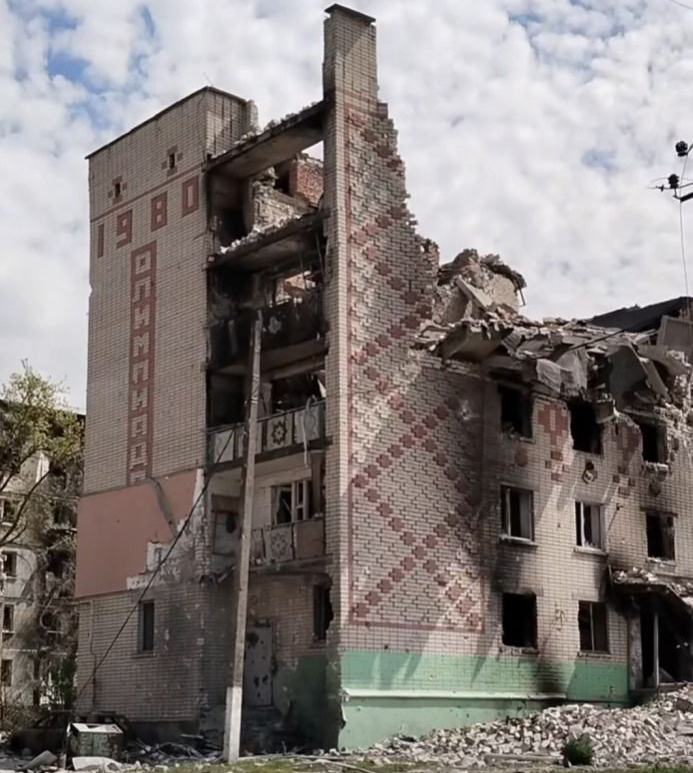
A destroyed apartment block on Olimpiiska Street in Oleshky. It used to house a Greenmarket shop
Unmotivated and illogical murders
Does the Oleshky Military Administration keep in touch with those who have remained in the town?
Certainly! We are aware of everything that is happening, as we are following every single detail coming from across the Dnipro. After all, this is not just a general human concern – each of us has relatives there.
What are the residents of Oleshky eating in the absence of food supplies?
There is still a little flour left in the town, which is selling at crazy prices – per cup. So people are baking all sorts of flatbreads from this flour and whatever other ingredients they can find. Those with more stamina walk through the ruins, searching for intact jars and food supplies. When the contents of the jars are eaten, the brine is not poured away. They add flour and bicarbonate of soda to it, and then bake flatbreads again. They cook over open fires or in wood-burning stoves. Because there is almost no liquefied gas left. And there has been no electricity, gas or water supply in Oleshky for four years now. Meanwhile, around 1,700 people remain in the town, including 47 children.
Children?! Are the russians not even trying to evacuate them?
No, the russians are not evacuating anyone. They are indifferent to what happens to our people, just as they were during the June 2023 floods, when the occupiers blew up the dam of the Kakhovka Reservoir. According to our data, over the last four months, around fifty people have managed to escape from Oleshky community.
Do russians not deliver humanitarian aid to the town? They must know what the situation is like in Oleshky.
The last attempt to deliver food was on 15 April, but it failed. Between 25 March and 15 April, around five vehicles managed to reach the town. When one of our local business owners began selling food outside a shop on 5 March (the shop had not yet opened, but people had been queuing since the night before), russian drones swooped in and killed four people and injured fifteen. That, it turns out, was the price of russian food.
But why would the russians waste drones on civilians who have been living in the territory they occupy for five years now? After all, there are surely some among them who are loyal to the russian authorities…
American journalists who came to Kherson asked me that very question recently. Indeed, why on earth are the russians doing all this?! Why do they need this war at all?! Why have they invaded us with their ignorance and their disgusting slavery?! What can they offer us, apart from suffering?! How can any sane person make sense of their actions?! I see no logic in them whatsoever! It is simply some kind of bestial desire to kill other humans.
‘15 March 2026
…We, the neighbours, share whatever we can with one another. One day, V. gave me a small loaf of bread (probably from the Baptist congregation). It was baked from some sort of grey flour – dreadful, grey and stale, but it was real bread. I took some of the bread to H. We’ve never been so happy about a piece of bread! V. gave me some carrots; a friend had given them to her from her cellar. Carrots! Real ones! I still had some mayonnaise left (bought before the snowfall), so I made a salad of grated carrots with garlic and mayonnaise. I took it to H. How surprised and delighted she looked! V. had managed to get hold of some flour from somewhere – we could make pancakes again. I’d got used to making them on the stove using H.’s recipe: using tomato juice instead of sour milk as the base. And I’d add fine cornmeal to the flour to use less of it…’
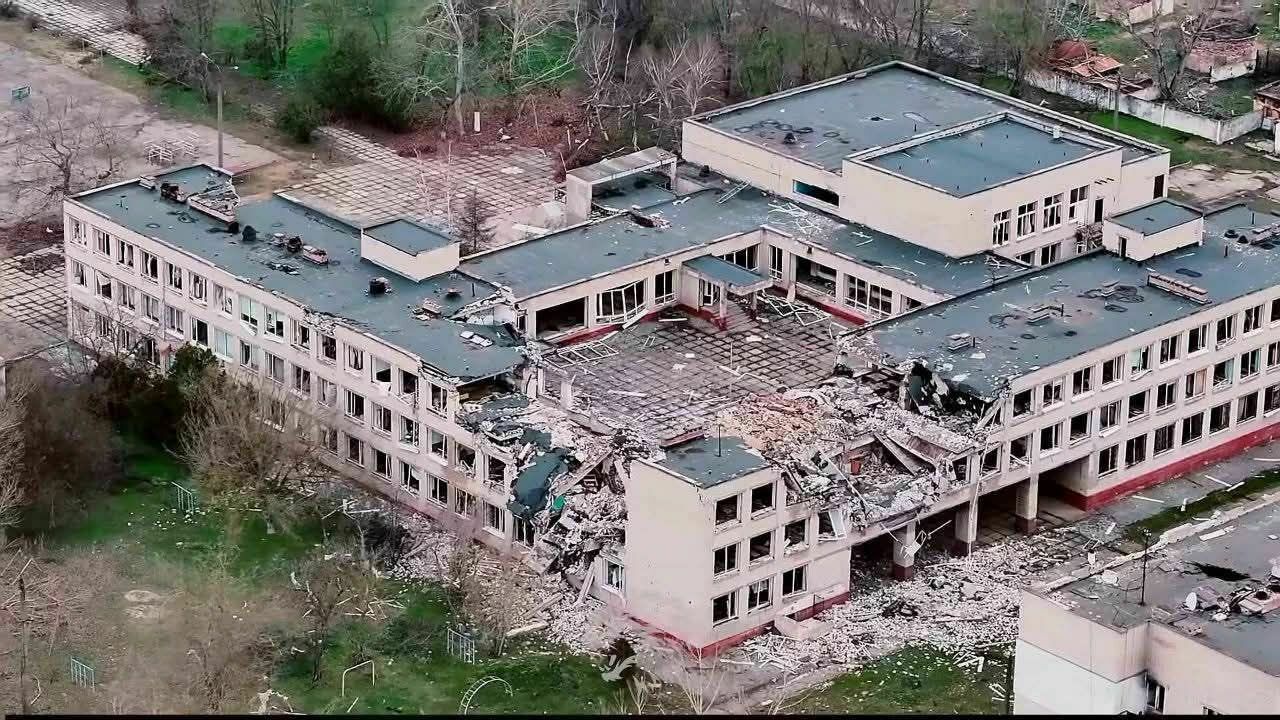
Oleshky School No. 4 now
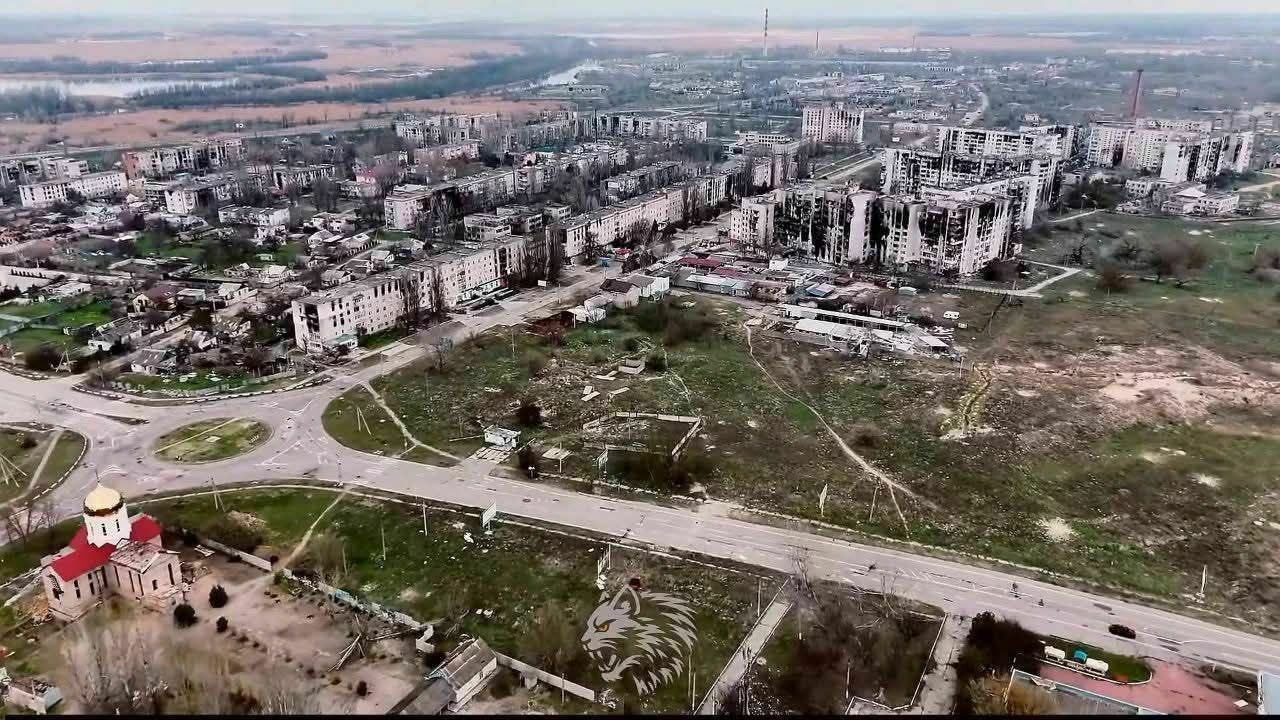
Oleshky viewed from a height. Parts of the buildings’ facades have turned black after the fires
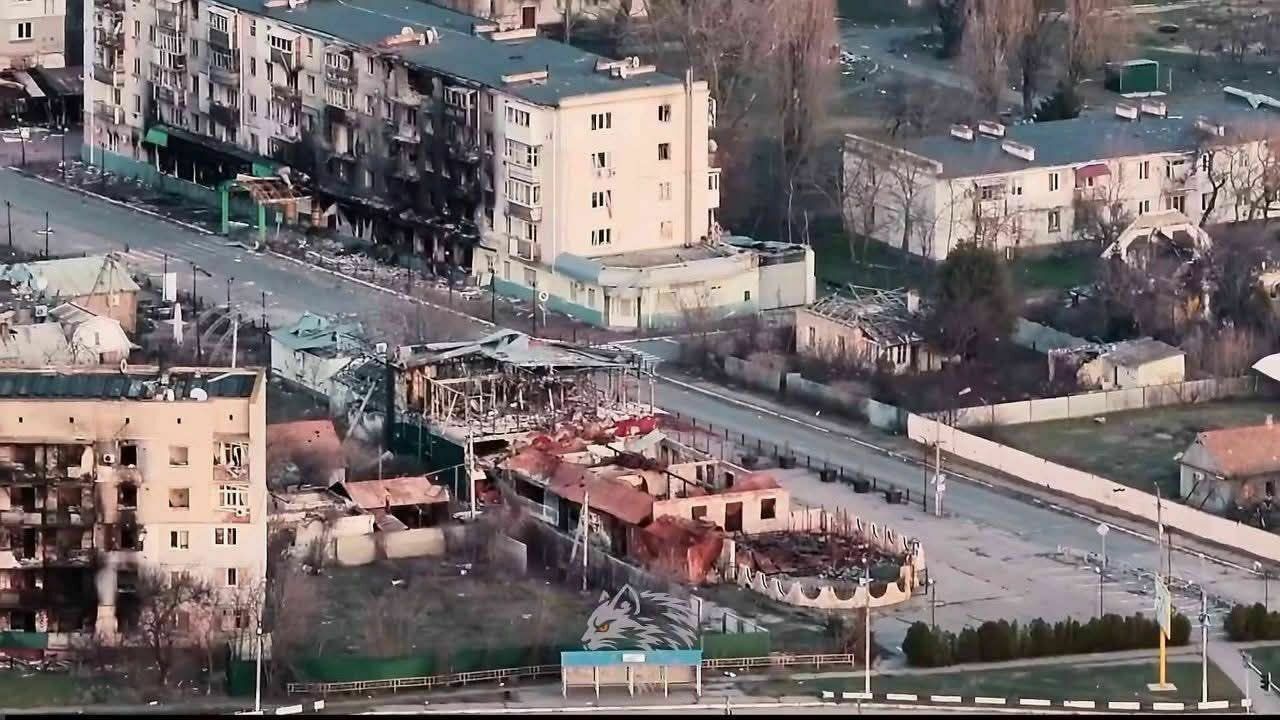
Residential district Zhytloselyshche in Oleshky now
Worse than death
You mentioned the absence of ambulances in the community. Does that mean people are completely deprived of medical care?
Fortunately, not completely. Although practically the entire infrastructure of the town has been destroyed, our hospital is still operating. However, it is mostly staffed by junior medical personnel. And there are only three doctors. Of course, people are enormously grateful to them all for the chance to receive basic medical care. But there really have been no ambulances in the community for three years now. So the wounded or seriously ill simply die. They are lucky if a neighbour or acquaintance spots such a person and takes them to hospital, say, in a garden wheelbarrow. But what if not? Under such conditions, dying is actually the lesser of two evils.
What do you mean? What could be worse than death?
I mean the impossibility of not just a dignified, but even a normal burial. People are no longer being buried in coffins, only in body bags. And these burials are unofficial, because to obtain permission for an official burial, the deceased would have to be taken all the way to Kalanchak for a post-mortem examination. But at the moment, such a journey is impossible. The bodies of those who were blown up by landmines whilst trying to leave the town are not being collected, and they become food for birds and wild animals. In Oleshky itself, the situation is not much better. Dead bodies sometimes lie simply on the streets or in flats, and there is no one to bury them. Parts of these bodies are dragged around the town by feral dogs. We have photographic and video evidence of this. The Oleshky mortuary, which is full of dead bodies, has been damaged.
You said ‘feral dogs’. Are they dangerous to people?
They are very dangerous and very fierce indeed! One woman described how a pack of hungry feral dogs chased her bicycle, not even reacting to the flatbread she threw at them, hoping they would focus on the food instead. They were not distracted because, in their minds, food means people. Cats have long since disappeared from the community. Some local residents catch and eat pigeons. And this, just think, in the 21st century, practically in the heart of Eastern Europe. I want you to write exactly this: ‘Save Oleshky! Stop russia! Otherwise they will wage war on other countries!’ We must not turn a blind eye to what these russian monsters are doing!
‘19 March 2026
…I’m on my way to the market. At the crossroads lies the body of a russian soldier. His face has been gnawed by dogs. People aren’t surprised by this anymore – bodies with gnawed limbs, pecked by birds, lie scattered around the town. No one is in a hurry to clear them away. But all those who have died from their wounds are taken to the hospital – to the mortuary and the basement. There they lie in black bags, waiting to be taken away for post-mortem examination. Yet for almost two months now, no one has come for them. But no one is allowed to bury them either. The heat will soon be unbearable. God, what if an infection spreads through the town? Rumour has it that a shop near the hospital will be handing out humanitarian aid. But only to those over 80… Who can make it there at that age? And what about the others, the younger ones – don’t they want to eat?..’
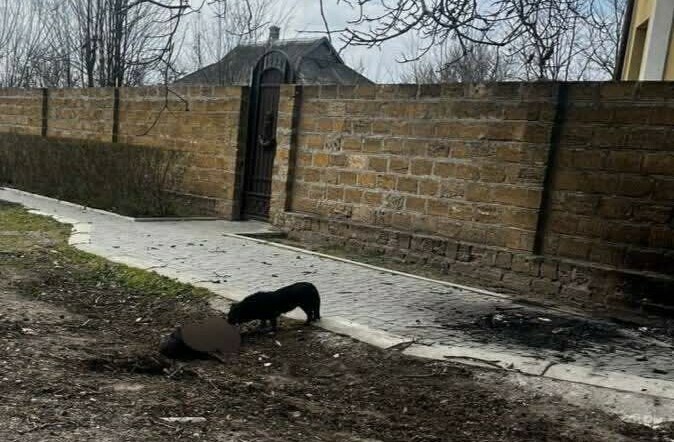
Feral dogs are running about Oleshky, dragging the remains of human bodies through the town. No one is picking up the dead bodies from the streets
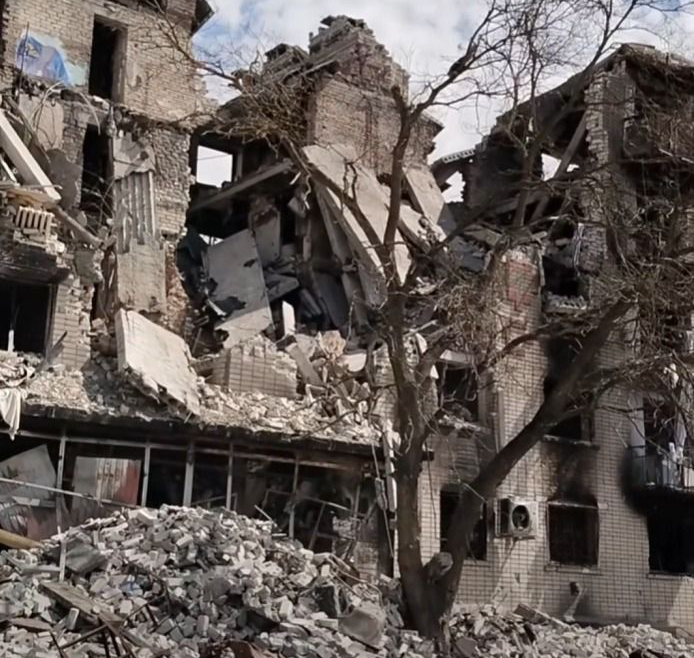
Many houses in Oleshky look like this now
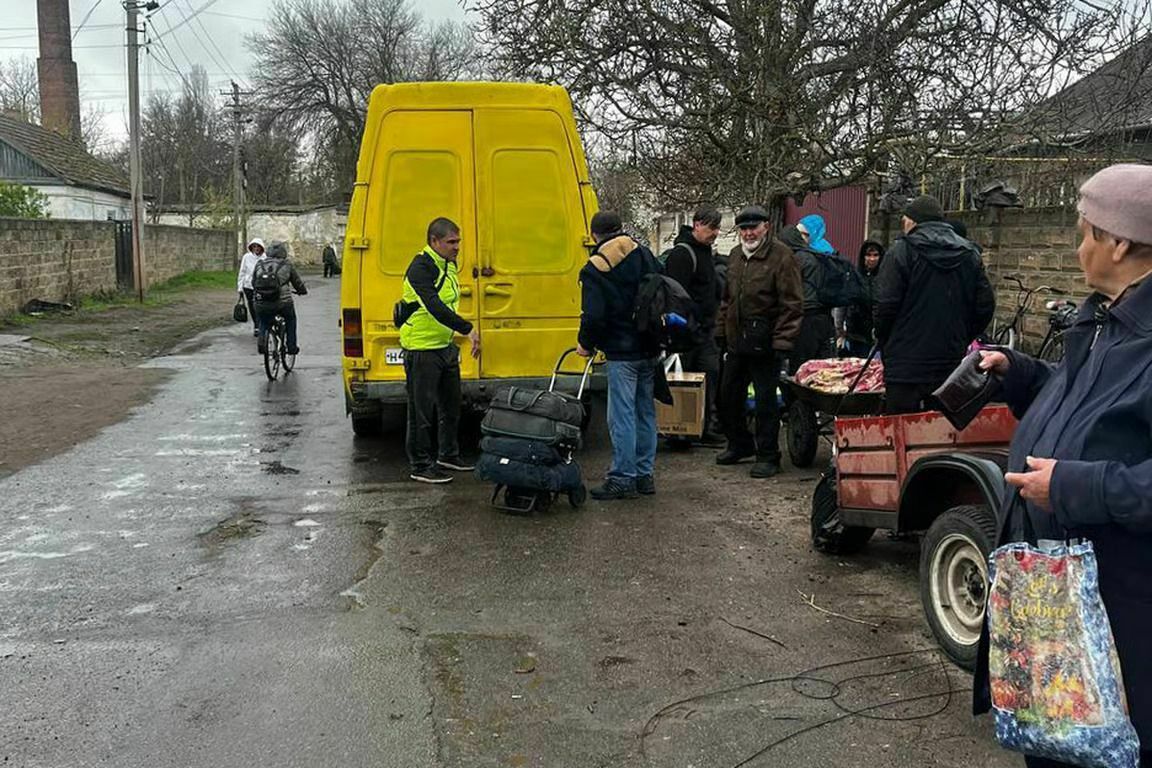
One of the few vehicles that managed to bring supplies to Oleshky
Community in pain
To what extent is the situation in Oleshky community typical of the occupied territories?
I find it difficult to generalise, as I am not sure exactly what is happening, for example, in the neighbouring Nova Kakhovka community or in the towns and villages further up the Dnipro. Instead, I can tell you that, in my view, Oleshky community has suffered more than any other from the russian aggression. Consider this: of our 13 localities, five have been completely destroyed. One of them is Krynky village, where the Ukrainian army held a stronghold for quite some time; it has not simply been destroyed, but literally reduced to dust. Pishchanivka, Pidstepne, Zaplava, Sahy also lie in ruins… In Solontsi and Kozachi Laheri, half the houses are destroyed. Besides such heavy fighting and all the ‘joys’ of occupation, our community has endured a flood caused by the russians blowing up the dam of the Kakhovka Reservoir. And now Oleshky has been under a complete siege for two months, causing people to starve. The russians, who are practically losing their minds when talking about the siege of their Leningrad during the Second World War, have themselves imposed a blockade on our Oleshky… Is there another community in Ukraine, do you think, that has suffered as much as we have?! Before the full-scale invasion, we were very prosperous! You have probably heard of our unique forests and our Oleshky Sands – the only desert in Ukraine? Their ecosystems are doomed. Now there is only death there.
Can causing famine in Oleshky be described as a distinct russian crime?
Definitely! And we must not just talk about this crime; we must shout it to the whole world! I think that when Oleshky is finally liberated, the whole world will be horrified by the scale of this crime. Overall, as a result of the russian invasion, the death toll in Oleshky community is not in the hundreds, but in the thousands! We cannot estimate the exact number at present. Similarly, we cannot yet assess the damage inflicted on the community as a whole… Just before the full-scale invasion, we discovered a soldiers’ burial site and an ammunition depot dating from the Second World War. That is, 75 years after it ended! And back then, the level of weaponry was not what it is now, nor was the density of landmines. Can you imagine how long after the end of the current war its traces will continue to harm people!? Right now, literally every metre is mined.
How to save the people trapped in Oleshky?
My opinion is that there is only one option: they can be ferried across the Dnipro to Kherson. That is the only evacuation route; everything else is mined. Kherson, incidentally, is clearly visible from the banks of the Dnipro, and in some houses Ukrainian mobile signal can be picked up from Kherson’s telecommunications towers. The territory controlled by the Ukrainian government is very close to Oleshky, but permission from the russians is needed to evacuate people. And this must be demanded by all kinds of international organisations, right up to the UN. We, the Ukrainian government, MPs and the Regional Military Administration are all engaged in dialogue with the occupiers on this matter. I want to emphasise the role of Oleksandr Prokudin, Head of the Kherson Regional Military Administration, in this dialogue. He is personally making enormous efforts to save people. But everything here depends on the russians. If they do not grant permission for evacuation via the Dnipro or do not provide people with food, these people will die. To be honest, I do not believe that anything can be agreed with the russian criminals. I have already seen how they ‘rescued’ people during the floods. But if we put pressure on them, perhaps they will agree to the terms being offered.
Is the Oleshky Military Administration documenting russian crimes?
Indeed, we are keeping a record of civilian casualties and determining the causes of their deaths. Eventually, all this data will be presented to the UN and other international organisations. We are also collecting all the information on russian crimes, based on people’s accounts, which we write down or record on a dictaphone. It is a truly horrific, unbelievable chronicle of our community, one that would never have existed if it were not for the russian invasion. But one way or another, this is our history. The history of a community that, despite everything, is alive. Its territory may be occupied now, but a community is not just land; it is, above all, people: both those currently living in territory controlled by the Ukrainian government and those living under occupation or abroad. Each of them, by the way, can contact our helpline or email us and share what they know. We also try to respond to all requests from people. Because we care about everyone.
Is there anywhere to evacuate residents if the russians allow their evacuation via the Dnipro? We are talking about 1,700 people…
From the very beginning, we have been involved in a very good project called Shoulder to Shoulder: Cohesive Communities. Even now, our partner communities are caring for our children, the families of our combatants and fallen soldiers, our family-style children’s homes, and more. We have signed agreements with Shumsk community in Ternopil region, Novyi Rozdil community in Lviv region, Uman and Monastyryshche communities in Cherkasy region, and Mukachevo community in Zakarpattia region. I am certain we would find a place for our residents there. Moreover, we have the opportunity to allocate accommodation for our people in modular housing estates in Kherson region. So the accommodation is ready, we just need the people to be allowed to leave. Please write about this and share your article on all social media platforms! We must save the residents of Oleshky! People should not be dying of starvation in the 21st century!
22 October 2026
III Міжнародний форум агломерацій в Україні: навіщо громадам діяти разом
III Міжнародний форум агломерацій в Україні:...
Транспортні маршрути, вода, критична інфраструктура та відбудова не зважають на адміністративні межі. Щоб громади...
22 October 2026
Олена Шуляк: громадам потрібно спільно...
Війна, внутрішня міграція та масштабна відбудова загострили питання, які не вкладаються в межі однієї громади. Про це...
22 October 2026
Віталій Безгін: агломераціям потрібні зміни до секторального законодавства
Віталій Безгін: агломераціям потрібні зміни до...
У Львові розпочався III Міжнародний форум агломерацій в Україні «Співпраця громад у функціональних територіях». У...
22 October 2026
У Львові розпочався III Міжнародний форум агломерацій в Україні (наживо)
У Львові розпочався III Міжнародний форум...
У Львові розпочався III Міжнародний форум агломерацій в Україні «Співпраця громад у функціональних...