Is it really enough simply to identify several institutions and adopt the relevant resolution in order to establish a network of academic lyceums?
This process actually requires a much more in-depth analysis: primarily, of the number of future senior school students and the teaching staff, the availability of appropriate material and technical resources, the ability of the educational institution to offer different profiles (at least three), and other preconditions that will influence the quality of educational services received by senior school students.
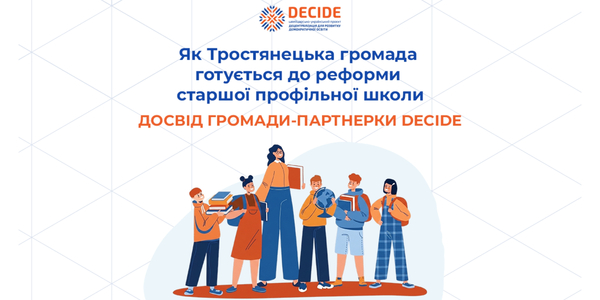
We want to share with you the experience of the frontline Trostianetska urban community in Sumy region – a partner community of DECIDE Project.
During April-June, National Expert Serhii Yatskovskyi and a team of Regional Experts that included Alla Bondar, Olena Hulenko, and Yurii Orel held a series of consultations with representatives of the community. Together with the community leadership, staff from the education department, and heads of educational institutions, they analysed the existing school network and possible models for its transformation.
At the start of the consultations, the community was considering the possibility of establishing three academic lyceums. However, a detailed analysis of the student enrolment, demographics, the location of the educational institutions, the security situation, and legislation requirements showed that this model needed to be reviewed.
Based on the results of this joint effort, a different approach has been developed: during the transitional phase (until 2030), it is proposed to maintain two academic lyceums in the community; thereafter, taking into account the factors mentioned above, a single, strong academic lyceum will be established. This model will enable schoolchildren to choose their own educational trajectory, provide the opportunity to have more than six specialisation profiles in the lyceums, and, at the same time, allow for the effective use of the community’s resources.
The experts paid special attention to:
- defining future educational profiles based on surveys of students and their parents, as well as existing staffing and material and technical resources;
- bringing the structure of academic lyceums into line with the legislation;
- preparing teaching teams to work in specialised senior secondary schools;
- developing careers guidance and partnership with universities and employer;
- establishing inter-municipal cooperation with neighbouring communities.
In particular, Trostianetska community plans to cooperate with Boromlianska community, which does not intend to establish an academic lyceum. The next step is to draft a cooperation agreement so that students from the neighbouring community can receive specialised secondary education at the lyceums in Trostianets.
An important outcome of the consultations was not only the proposed model for the future network. The community has also prepared presentation and communication materials which can be used in future work with local councillors, the public, potential donors, and partners.
As Anna Zubova, Head of the Education Department at the Trostianets City Council, notes, ‘The consultations provided us not only with answers to complex questions about the future network, but also with tools for our future work. Thanks to the experts, we now have a presentation that will help us present our model in a justified manner to different audiences – from local councillors and parents to potential donors. This is important, as the success of the reform depends largely on open communication and trust in the decisions taken.’
The experience of Trostianetska community shows that the main aim of the reform of specialised senior schools is not a mere reduction in the number of institutions or their renaming, but the search for a model that takes into account the real needs of children and the capabilities of the community, and ensures quality specialised education for years to come.
Upon request, the experts continue to provide consultative support to communities on the creation of academic lyceums and the development of an effective network of senior schools. If you represent a community and would like to receive practical expert advice, please submit a request via the link.
Tags:
education vocational training college
Область:
Сумська областьSource:
Проєкт DECIDE
18 September 2026
Вакансія: Експерт(-ка) з дошкільної освіти
Вакансія: Експерт(-ка) з дошкільної освіти
Опис контексту Щоб задовольнити мінливі потреби українських муніципалітетів і зацікавлених сторін на національному...
18 September 2026
Вакансія: Експерт(-ка) з місцевих фінансів (в напрямку «Фінансова децентралізація»)
Вакансія: Експерт(-ка) з місцевих фінансів (в...
Опис контексту Щоб задовольнити мінливі потреби українських муніципалітетів і зацікавлених сторін на національному...
18 September 2026
Управління відходами – з чого почати? Шість продуктів, які полегшать громадам роботу
Управління відходами – з чого почати? Шість...
Якщо ви займаєтесь управлінням відходами чи приблизно уявляєте собі обсяг робіт, напевно, не раз задумувались: як це...
18 September 2026
Святкуймо День співпраці Interreg в Україні 2026
Святкуймо День співпраці Interreg в Україні 2026
21 вересня Україна долучиться до Дня співпраці Interreg — загальноєвропейської кампанії, що підсвічує результати...