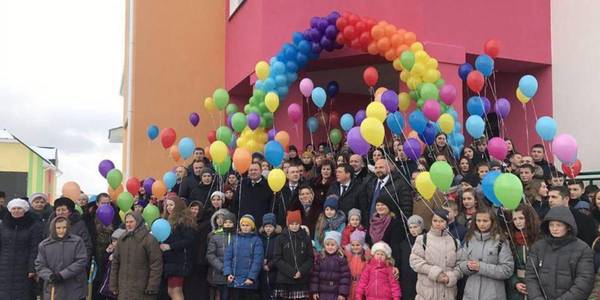
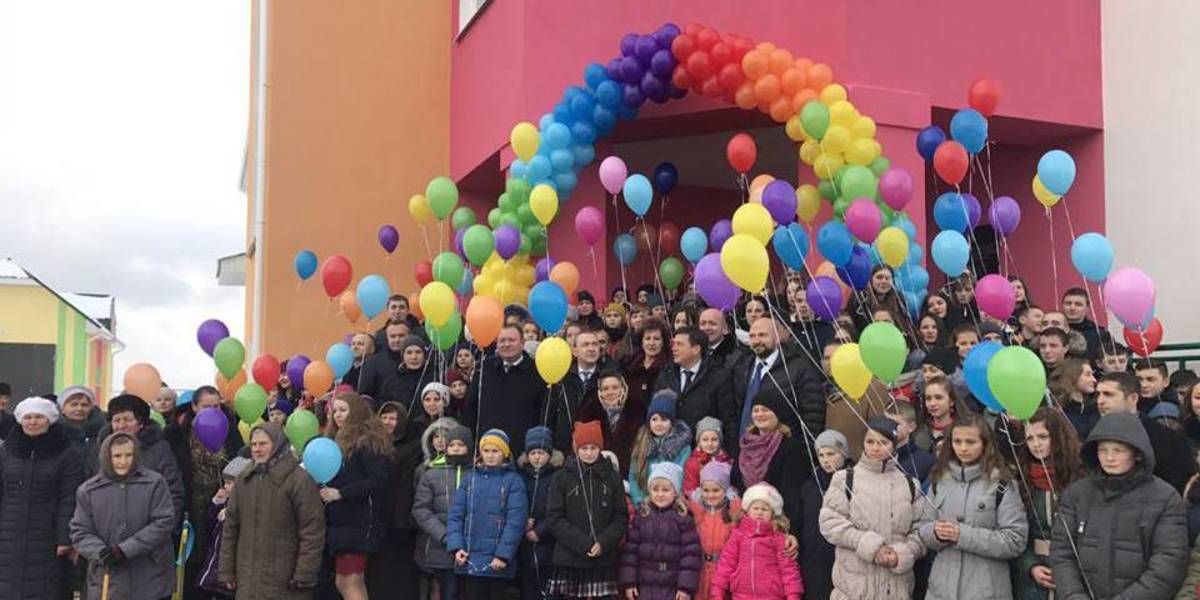
Hennadii Zubko has opened new school in Piskivska AH of Rivne Oblast
Our goal is to provide children with high-quality education, irrespective of school location. The New Educational Space (NES) should not only give a certain set of knowledge, but first and foremost – motivate a child to study. A school is not only 45% of time a child spends for learning process. The school should be an educational hub, where children can come and receive both basic and extracurricular education, as well as comprehensive development. Therefore, it is important to establish a variety of school interest clubs, theaters, additional courses to master trades, emphasised Hennadii Zubko, Vice Prime Minister – Minister of Regional Development, Construction, Housing and Communal Services of Ukraine, at the opening of the new Piskiv secondary school in the Rivne Oblast built under the standards of the the NES for 226 children.
“In the nearest future, we have to provide the Piskiv school with the status of a hub school and establish necessary creative space for modern children: interactive whiteboards, physical and chemical laboratories, ability to interactive learning and inclusion. On the basis of this school, we form a new educational space in the whole area, founded on European educational principles. It is not just about a good energy-efficient building and comfortable classrooms – it is, first of all, a new dimension of education, a new philosophy of learning,” said Hennadii Zubko.
He is convinced that the new school will fill the village with life, as almost 2,5 thousand residents live on the territory of the Piskiv village council. “Ukrainians are waiting for changes that become implemented in education, healthcare, infrastructure! And these changes will take place due to the decentralisation reform, that has already started to produce positive results. 457 hub schools with 909 affiliates, and 144 hub schools in AHs have been established so far. Almost 37 thousand students are being transported to secondary schools by school buses,” said the Vice Prime Minister.
The Piskiv village school was founded in 1952 as a seven-year educational establishment, then it received the status of a secondary school, and was further reorganised into a general secondary establishment. By 1974, children were studying in 6 classrooms of the wooden building, and later the bricked premises were added. Though in 2001 the building received an emergency status. In 2016, the village finally started building the new educational premises. In 2017 the work continued, envisaging over UAH 23 million: 90% - from the State Fund for Regional Development, 10% - from the local budgets.
Tags:
Область:
Рівненська областьГромади:
Пісківська сільська об’єднана територіальна громадаSource:
Прес-служба Віце-прем’єр-міністра України
08 June 2026
Олексій Рябикін: «Політика згуртованості починається не з ресурсів, а з правильних рішень»
Олексій Рябикін: «Політика згуртованості...
Успішне впровадження підходів Політики згуртованості ЄС залежить не лише від доступу до фінансових інструментів, а...
08 June 2026
Розділ 22 і майбутнє громад: Україна почала предметну підготовку до Політики згуртованості ЄС
Розділ 22 і майбутнє громад: Україна почала...
Підготовка України до вступу в Європейський Союз дедалі більше переходить із площини загальних політичних декларацій...
08 June 2026
Чотири бар’єри міжнародної співпраці громад: що показало дослідження 316 громад
Чотири бар’єри міжнародної співпраці громад: що...
Верховна Рада нещодавно ухвалила законопроєкт №10284, який дозволяє органам місцевого самоврядування...
08 June 2026
Нові правила сортування відходів: як Україна наближається до європейської системи
Нові правила сортування відходів: як Україна...
В Україні ухвалили зміни до Методики роздільного збору побутових відходів. Фахівці переконані, що нововведення...