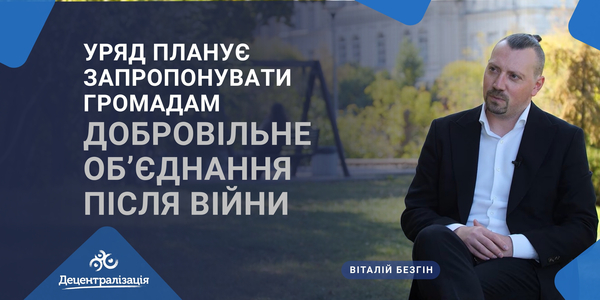
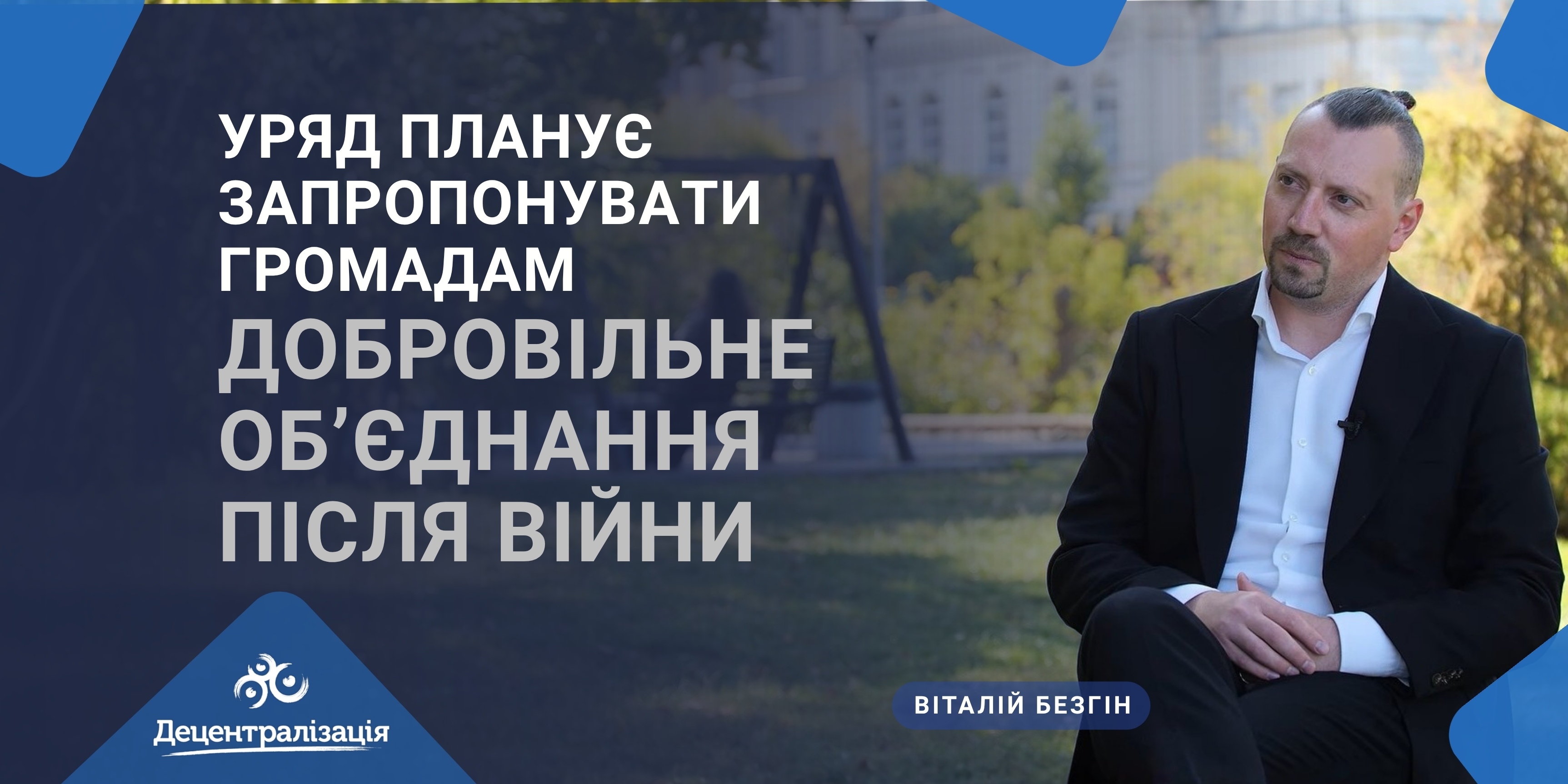
Vitalii Bezgin: Government plans to offer communities voluntary amalgamation after the war
No changes will be made to the administrative-territorial structure during martial law, and future decisions must be based on data on the population, migration, and the needs of communities. One of the possible post-war mechanisms is a draft law on the voluntary amalgamation of communities.
Vitalii Bezgin, Minister for Communities, Territories and Internally Displaced Persons, stated this in an interview with “18000” during a working visit to Cherkasy region.
When asked about the possible enlargement of communities, the Minister described it as inevitable, but emphasised that such changes cannot be implemented during the full-scale war. According to the Minister, adjustments to the administrative-territorial structure lead to early local elections, and these are not held during martial law.
Another reason not to rush into decisions is the lack of reliable data. Vitalii Bezgin noted that the state does not have complete information on the actual population size, migration, and the number of internally displaced persons. Without this, he said, it is impossible to accurately model the capacity of communities and assess how they will deliver services.
“Qualitative criteria” for such decisions, in the Minister’s view, can only be established once the full-scale war has ended, when the situation becomes more stable and it is clear how many people are returning to their communities. He also noted that it will be difficult to change the administrative-territorial structure quickly: the procedure requires the Government decision and amendments to the Verkhovna Rada resolution, whereas voting requires political consensus and at least 226 votes.
Voluntary amalgamation rather than a top-down decision
Vitalii Bezgin suggested voluntary amalgamation of communities as a possible solution. According to Mr Bezgin, the previous law on voluntary amalgamation has effectively run its course. The Minister expects the Government to prepare and table a draft law in October or November.
This refers to a situation where neighbouring communities themselves come to the conclusion that they lack the financial or other resources for independent development, decide to amalgamate, and follow the prescribed procedure. The Minister clarified that the proposed approach would not involve the long-term plans that were used during the previous stage of the reform.
Vitalii Bezgin suggested that small communities around regional centres might amalgamate with one another – particularly if they have a similar economic structure – rather than join the regional centre itself. He refused to accept a scenario in which such communities would simply be “swallowed up” by the metropolis.
Meanwhile, the Minister emphasised the need for cooperation between neighbouring communities on shared issues. His examples included the management of solid household waste and inter-municipal transport. Such interaction, he said, should develop through cooperation rather than forced amalgamation.
02 November 2026
Planning the development of the network of academic lyceums
Planning the development of the network of...
In July 2021, the Verkhovna Rada of Ukraine amended the Law of Ukraine “On Comprehensive General Secondary Education”...
02 November 2026
Ресурси для відновлення та розвитку: нові можливості для громад і бізнесу у листопаді
Ресурси для відновлення та розвитку: нові...
Сьогодні українські громади щодня проходять випробування на стійкість. Російські атаки, перебої з...
02 November 2026
Економічна стійкість країни починається в регіонах: шість проєктів ініціативи Produce!
Економічна стійкість країни починається в...
Війна щодня випробовує економіку України на міцність: руйнуються підприємства, порушуються виробничі ланцюги,...
02 November 2026
Реформування комунальних підприємств: для громад підготували практичний посібник
Реформування комунальних підприємств: для...
Реформування комунальних підприємств: для громад підготували практичний посібник Аналітичний центр EU-LEAP спільно...