‘I choose the future in Ukraine!’
What is necessary to ensure that every school leaver can say exactly that?
Understanding one’s own strengths is more important than simply knowing the names of professions. It is not just about hearing about the labour market; it is about getting to know real professions, organisations and the people who work there. Most importantly, it is about exploring the different educational and professional opportunities available in order to make a conscious choice.
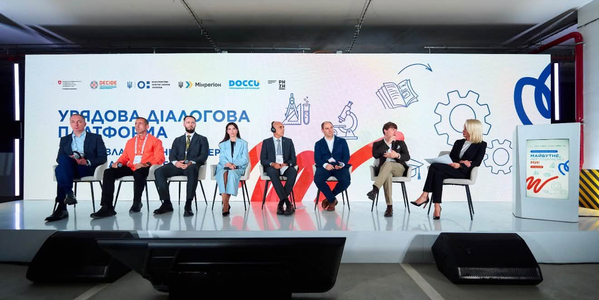
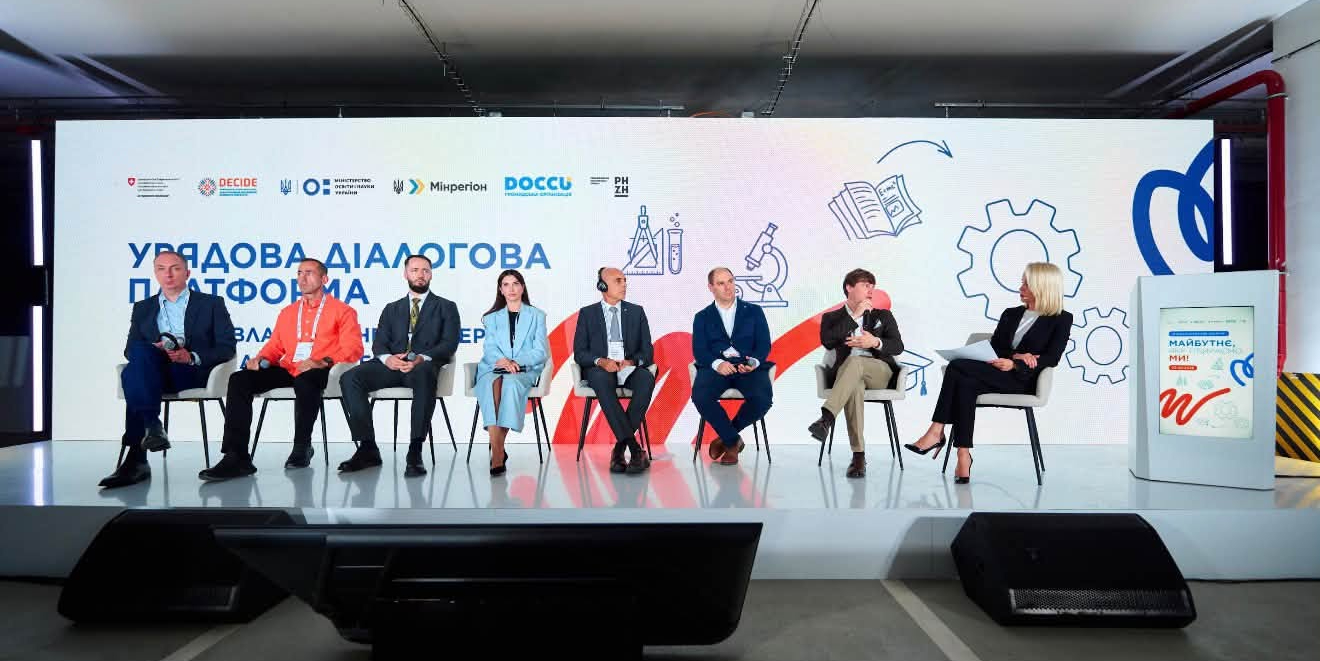
Discussions on how such a system is developed today were held during the government dialogue platform «Education, Government, Business: Synergy for the Future» during our National Forum «The Future We Choose!»
The Forum was organised by the Swiss-Ukrainian DECIDE Project in cooperation with the Ministry of Education and Science of Ukraine.
Career guidance in schools should become systematic
Choosing a profession does not happen overnight – in Grades 9 or 11. Students need to gradually learn about themselves, their interests and abilities, and learn about different professions and educational opportunities.
Therefore, careers guidance has to be an integral part of the educational process, and there should be someone alongside the child to help them along this path – a careers counsellor.
Dmytro Zavhorodnii, Deputy Minister of Education and Science of Ukraine, talked about this.
‘A careers counsellor should be included in the staffing structure of an educational institution, and careers counselling sessions should be a compulsory part of the school curriculum. There should be a careers coordinator in the community to ensure that cooperation between the education sector and the business sector takes place systematically, rather than as a single initiative.
The choice of profession should take into account the real labour market
What sort of specialists will Ukraine need in five or ten years’ time? What sort of employees are businesses already looking for today? And how can we help young people to recognise these opportunities before they make their educational choices?
Dariia Marchak, Deputy Minister of Economy and Environment of Ukraine, spoke about the link between career guidance and the needs of the economy and the labour market.
‘Three out of four companies are struggling to fill vacancies. There is a particularly acute problem in filling vacancies for technical and blue-collar professions, across all fields where knowledge of mathematics, physics, chemistry, and engineering is necessary. We need to help young people not just learn about a profession, but to try it out. Career guidance is not just about tests; it is an opportunity to try out a specific profession for yourself.’
Vocational education is not a back-up plan
Another important discussion concerns the stereotypes that still influence the choices of children and parents.
Vocational and pre-higher vocational education provide the opportunity to gain in-demand qualifications, enter the labour market quickly, earn a good living, develop professionally, and continue studying.
Ukrainian MPs Bohdan Kitsak and Olha Koval spoke about the need to change attitudes to vocational education.
Olha Koval: ‘We should not set ourselves the goal of ensuring that the majority of children enrol in vocational or technical pre-higher educational programmes. We need to create conditions in which vocational and technical pre-higher education are competitive options in this choice. Success will be achieved when parents and their children view vocational education as the primary pathway, rather than a backup plan.’
Bohdan Kitsak: ‘We need to understand where the businesses are located, what the demand for workers is, which vocational colleges exist, and whether they train the specialists that these businesses are looking for. We need to align the career guidance system you are currently developing with the economy. Only then will it work in synergy.’
Career guidance for frontline communities is also a talk about the future
Oleh Hryhorov, Head of the Sumy Regional Military Administration, spoke about the region’s experience of sustaining and developing education in the face of constant security threats.
Despite the war, communities continue to create opportunities for children. Because the questions of where they will study, what they will become, and whether they will see a future for themselves in their community and country are also questions of regional resilience.
‘Every project, every investment in children is also a victory for us in our European aspirations. For Sumy region, such cooperation is an investment in our children, the educational process, and our shared future.’
Investing in careers guidance means investing in the future of young people
Jean-Luc Bernasconi, Head of Cooperation at the Embassy of Switzerland in Ukraine, also joined the discussion.
‘Swiss support is not charity, but an investment in Ukraine’s human capital. Career guidance builds a bridge between the education system and the economy. It is a win-win situation for everyone.’
Business can open up the real world of modern production to children
Dmytro Kysylevskyi, a Member of the Ukrainian Parliament, spoke about practical examples of cooperation between businesses, young people, and educational institutions.
‘All this is done in close cooperation with stakeholders, each of whom has their own interest and contributes to the process. Dnipro City Council contributes through renovations, teachers, and changes to the curriculum. Interpipe, as a business partner, contributes machinery, funding, and training equipment. The Polytechnic contributes intellectually by delivering training. In other words, everyone contributes. It does not happen by itself.’
It is not enough just to hear about a profession – one has to experience it
An excursion to a company, a talk with an expert, the chance to see modern equipment, or try their hand at a real-life task can tell a teenager far more about a profession than dozens of stories ever could.
The co-owner of Promavtomatyka group, Mykhailo Hanchuk, spoke about this very topic. The company organises excursions and master classes, sets up laboratories and implements projects that help young people gain practical experience in a particular profession.
‘Seeing and hearing about something is one thing, but actually being involved in the production of robotic manipulators, the manufacture of lighting fixtures, or the construction of solar power stations is quite another. They did just that. I am convinced that they will remember this, and remember it positively.’
The participants in the government discussion were united by a shared vision: every child should receive the knowledge, practical experience, and support necessary to make a conscious choice about their own educational and professional path. And could say with confidence:
‘I see opportunities. I can choose. I can build my future in Ukraine.’
Tags:
education Ministry of Education and Science vocational training college
Source:
Проєкт DECIDE
16 October 2026
Уряд спростив реалізацію проєктів за комплексними планами стійкості
Уряд спростив реалізацію проєктів за...
З 15 жовтня для проєктів у межах експерименту за комплексними планами стійкості діють оновлені правила. Уряд визначив...
16 October 2026
Профорієнтація в дії. Як Івано-Франківська громада виховує фахівців, які хочуть працювати вдома
Профорієнтація в дії. Як Івано-Франківська...
Уявіть дев'ятикласника, який упевнено заявляє, що мріє про кар'єру в IT лише тому, що чув про високі зарплати у цій...
15 October 2026
Правовий режим майна закладів освіти...
правовий статус майна комунальних закладів освіти та повноваження засновника і керівника закладу; які...
15 October 2026
«Я цінний для своєї громади й держави». Як у...
У Зимнівській громаді на Волині профорієнтація перестала бути формальністю. Тут не просто розповідають про...