Produce!: How communities can create conditions for new enterprises to emerge
The availability of a plot of land does not constitute an investment opportunity in itself. The presence of an industrial park does not guarantee the establishment of new manufacturing facilities. Similarly, the presence of a university or vocational college does not solve the problem of human resources if the training of specialists does not align with the actual needs of employers.
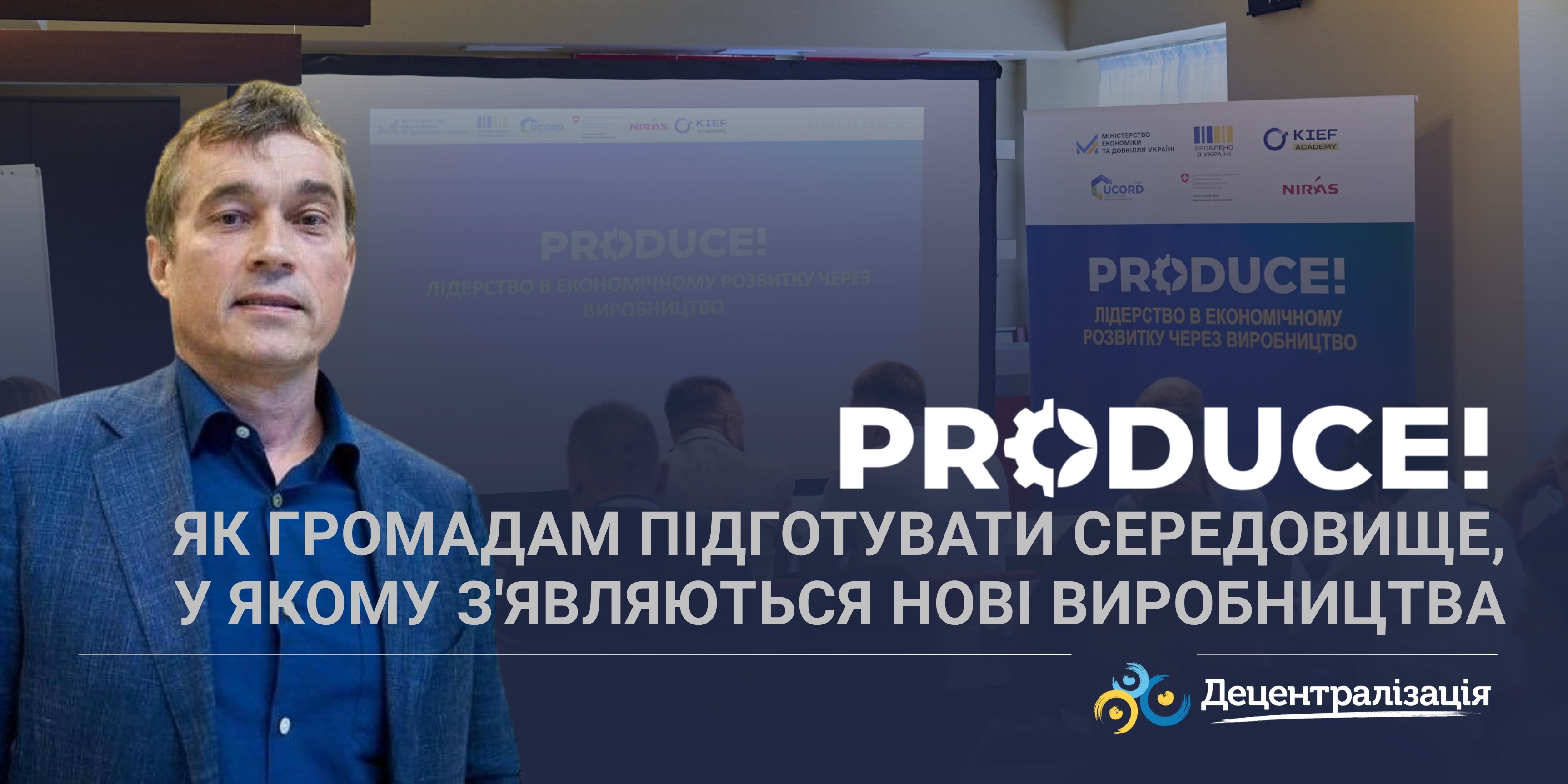
On the second day of the final module of the Produce! training initiative “Leadership in Economic Development through Production” the participants explored how to combine these elements into a system capable of attracting investment, creating jobs, and generating new economic activity around manufacturing.
Teams from Vinnytsia, Volyn, Odesa, Sumy, Ternopil and Khmelnytskyi regions are taking part in Produce! – including representatives from regional authorities, local self-government, regional development agencies, manufacturing businesses, and educational institutions. Their task is to prepare six regional development projects, which will subsequently be presented to the Government, the Office of the President, and international partners.
The programme is implemented by the KIEF Academy under the auspices of the Ministry of Economy and Environment of Ukraine, with the support of the Swiss-Ukrainian “Ukraine’s Cohesion and Regional Development” (UCORD) project, which is implemented with Swiss support by NIRAS Sweden AB.
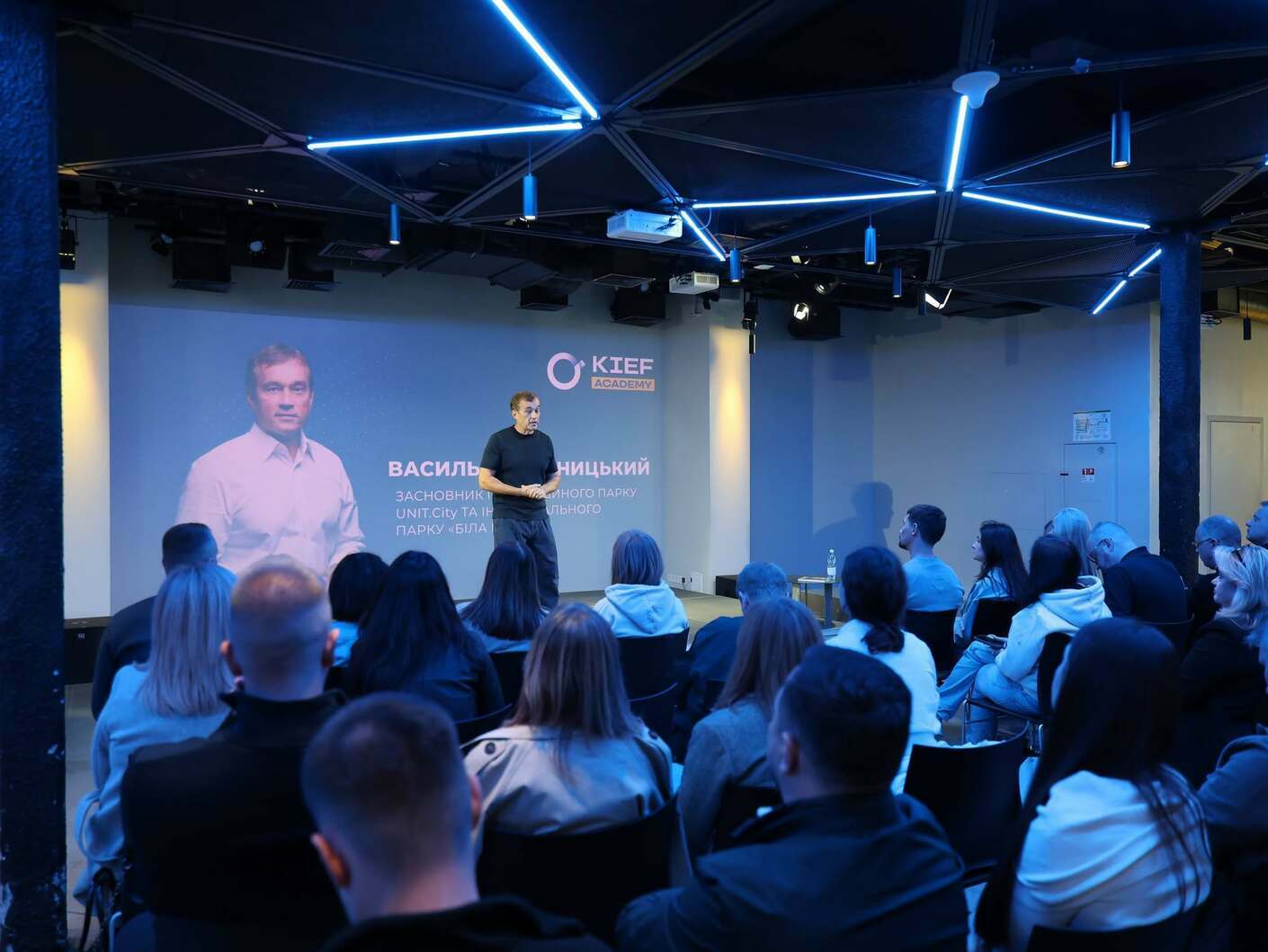
On the second day, the participants immersed themselves in active innovation and industrial ecosystems. First, at UNIT.City, they spoke with Vasyl Khmelnytskyi, the founder of UFuture, UNIT.City and the Bila Tserkva Industrial Park, about the environment for business and manufacturing development. Later, in Bila Tserkva, they examined this model from the perspectives of the community and the industrial park operator with Vasyl Morskyi, Deputy Mayor of Bila Tserkva, and Andrii Ropitskyi, Director of the Bila Tserkva Industrial Park.
An ecosystem rather than a single facility
One of Vasyl Khmelnytskyi’s main messages is that economic development should not be limited to the creation of one large company.
Using UNIT.City as an example, he explained the logic behind an ecosystem in which different businesses operate alongside one another, sharing knowledge, finding partners, and creating new products and companies. A similar principle applies in the industrial park, but with a focus on manufacturing. A business requires not only land and premises, but also engineering infrastructure, staff, education, services, suppliers, and an environment conducive to growth.
‘The key to this prototype is the ecosystem. Businesses from different sectors interact with one another, share information and experience, and create new ventures,’ explained Vasyl Khmelnytskyi.
For Produce!’s regional teams, this changes the scale of project development entirely. A development project must consider not only what kind of production can be established, but also the requirements for its emergence, development, and the forging of new economic links.
Jobs as an economic multiplier
Vasyl Khmelnytskyi also emphasised the importance of assessing the outcome of industrial development.
Tax revenue from a new enterprise is important for the community. However, its impact is much broader than that. Employees receive wages and spend them in the city. The enterprise requires logistics, catering, repairs, maintenance, and other services. In this way, a manufacturing job creates demand for employment in other sectors.
‘People’s wages and jobs come first,’ emphasised Vasyl Khmelnytskyi.
From this perspective, manufacturing becomes a tool for developing not only industry, but also the local economy as a whole. Vasyl Khmelnytskyi therefore suggested looking at the labour shortage from a different angle.
‘My goal is to have a shortage of staff. That is my dream,’ he said.
The logic behind this seemingly paradoxical statement is simple: when businesses start competing for workers, the cost of labour rises. The opportunity to earn a good living, combined with high-quality education, healthcare, and a comfortable living environment, becomes a factor that can keep people in their communities and encourage those who have left to return.

First the employer, then staff training
The issue of human resources emerged as a recurring theme throughout the day. Vasyl Khmelnytskyi gave the example of a potential investor who required 300 operators of modern equipment. Land, infrastructure, and premises can be prepared. However, it is much more difficult to find people with the necessary skills quickly.
For this reason, the Bila Tserkva Industrial Park combines production development with workforce training. This involves vocational education, working with schoolchildren and their parents, and providing opportunities for adults to retrain.
Andrii Ropitskyi provided an even more detailed description of this model: first, the employer’s needs are identified, then people are recruited and trained in the required profession, and prepared to work at a specific production facility. In other words, it is “recruitment with training”.
In the context of a regional project, the following practical question arises: if new production facilities are planned for the region, who will be working there in three, five or ten years’ time, and how is the education system preparing for this demand today?
Not to copy someone else’s scale
Participants in the Produce! initiative represent regions with varying economic structures, population sizes, industrial bases, and resources. Therefore, the successful model does not need to be copied in full.
‘There is no need to build an ecosystem for hundreds of production facilities or thousands of people. Create a small ecosystem right here in your own city,’ advised Vasyl Khmelnytskyi.
Such an environment could begin with just a few entrepreneurs, a training course, a partnership with an educational institution, or a small group of interconnected businesses.
The scale may vary. The principle remains the same: businesses, the education sector, the authorities and other stakeholders must recognise a shared economic interest and work together rather than in isolation from one another.
What the community has to do
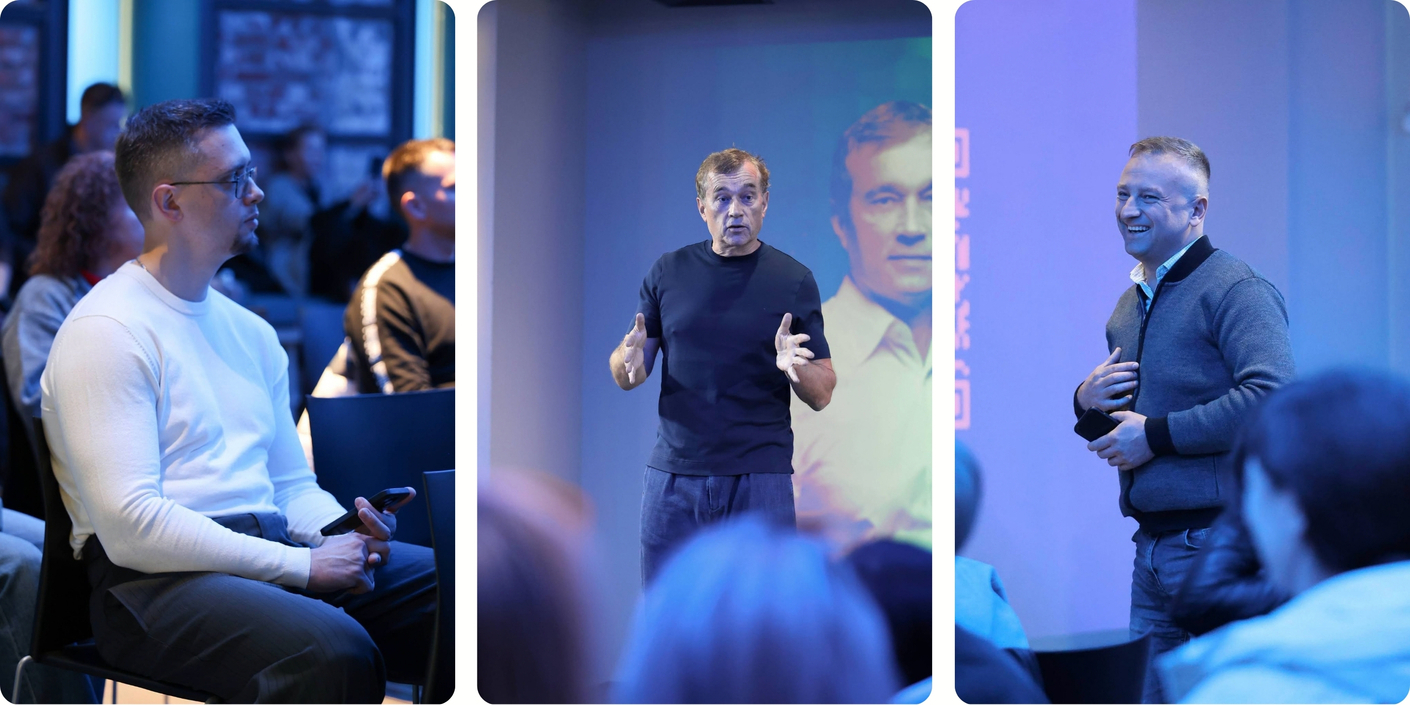
While the discussion with Vasyl Khmelnytskyi focused primarily on the logic of the ecosystem, in Bila Tserkva, participants were able to examine it from the perspective of local self-government.
One of the key takeaways is that industrial development begins long before an investor arrives.
Vasyl Morskyi stated that the community must identify the areas where production facilities can be located in advance. Without such designated areas specified in the city planning documentation, even a promising investment project will be difficult to implement.
‘In fact, the document that truly drives community development is the master plan,’ emphasised Vasyl Morskyi.
Industrial areas, in turn, influence the planning of housing, transport and social infrastructure. Spatial planning therefore becomes one of the tools of local economic policy.
Incentives should be targeted at achieving results
Another practical example from Bila Tserkva is the use of local tax incentives to develop industrial parks.
The community sets a zero land tax rate for the industrial park but views this as an economic tool. An assessment is made each year to determine whether the park is developing, if new facilities have been built, and if revenue and economic activity are growing.
This logic transforms the concept of incentives: the community foregoes some revenue today in the hope of creating a stronger economic base tomorrow.
A similar approach was adopted for infrastructure development. The city co-funded the road infrastructure for the industrial park with the state. For the community, this investment in the facilities used by different manufacturers should result in job creation and expansion of the local economy.
Investors need commitment, not just a land plot
Andrii Ropitskyi demonstrated the next level of this system.
A community may have land zoned for industrial use, but this does not automatically make it competitive for investors.
Andrii Ropitskyi set out three basic criteria for selecting a site: “Logistics, people, and communications. These are the key factors when choosing a location for a park.”
Potential investors consider more than just the cost of the land. They also consider how quickly raw materials and products can be delivered, whether there is a local workforce, and whether there is sufficient electricity, water, gas, and other utilities.
This leads to another principle: infrastructure must be prepared before the investor arrives. If it takes several more years to connect utilities and sort out planning permission after the investor has decided to launch a project, the site may be deemed unviable.
In this sense, an industrial park sells the investor more than just land and infrastructure. It sells time.
Investor support is a separate function
Having the infrastructure ready only solves part of the problem. A new manufacturer needs to liaise with local authorities, network operators, designers, builders and other stakeholders, and go through a series of other procedures. For a foreign company entering Ukraine for the first time, this process is even more complex.
Therefore, one of the roles of an industrial park management company is to guide investors through this process and minimise the time between deciding to invest and starting operations.
Experience has also shown that it is not worth trying to anticipate all of a future manufacturer’s needs in advance. Instead of premises that are rigidly designed for a specific technological process, a more versatile solution would be a space that tenants can adapt to their own production needs.
For Produce!’s regional projects, this means that a region’s readiness does not imply that businesses have to sort everything out themselves. What is needed are measures that reduce business risk and time to market while allowing flexibility to adapt solutions to specific investors.
From individual tools to a system
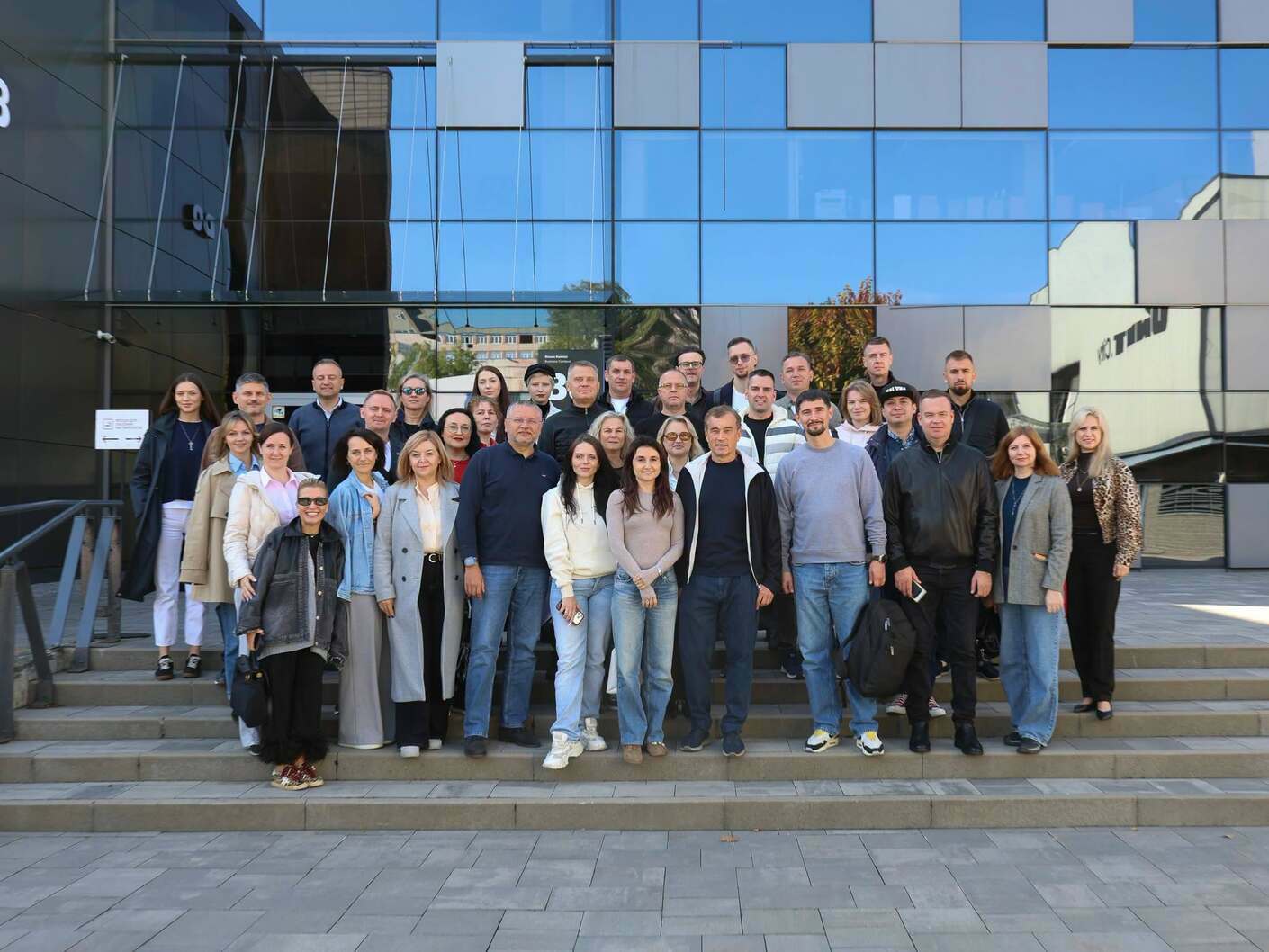
On the second day of the third training module of the Produce! initiative, participants examined the three levels of a single process one after the other.
Vasyl Khmelnytskyi explained why a region needs an economic ecosystem. Vasyl Morskyi demonstrated how the community can contribute to shaping it. Andrii Ropitskyi outlined the practical steps required to prepare the region for the arrival of a manufacturing investor.
The result is a coherent chain: spatial planning – a prepared industrial site – engineering infrastructure – investor support – production – workforce training – jobs – new economic links – community development.
In this way, the industrial park, vocational education, local tax incentives, infrastructure investment and engagement with investors are no longer separate measures, but instead function as parts of a single model for local and regional economic development.
As previously reported, on the first day of the final Produce! module, the participants examined this same challenge from different angles.
The article “From resources to factory: what regional teams learn through the Produce! initiative” discussed how to transform a region’s strengths into manufacturing projects, and resources into products with higher added value.
The article “When production conflicts with the rules of the game: Produce! lessons by Oleksandr Sokolovskyi” explores the conditions under which Ukrainian manufacturers operate and the barriers that cannot be overcome at the level of an individual enterprise or region alone.
One more article – “SWOT analysis as real-world testing: What Produce! initiative teams work on” – is dedicated to the teams’ work on their own regional projects. During the SWOT analysis, they assessed the viability of their production ideas, analysed staffing and infrastructure constraints, opportunities for cooperation, funding and regulatory barriers, and determined which solutions depend on the business or regional level, and which require government policy.
Tags:
regional development European Cohesion Policy study ucord
Source:
Портал "Децентралізація"
16 October 2026
До $65 тисяч на соцпослуги: Уряд масштабував програму Малих грантів на всі громади України
До $65 тисяч на соцпослуги: Уряд масштабував...
Кабінет Міністрів України ухвалив рішення, яке кардинально розширює можливості територіальних громад у розвитку...
16 October 2026
Уряд спростив реалізацію проєктів за комплексними планами стійкості
Уряд спростив реалізацію проєктів за...
З 15 жовтня для проєктів у межах експерименту за комплексними планами стійкості діють оновлені правила. Уряд визначив...
16 October 2026
Профорієнтація в дії. Як Івано-Франківська громада виховує фахівців, які хочуть працювати вдома
Профорієнтація в дії. Як Івано-Франківська...
Уявіть дев'ятикласника, який упевнено заявляє, що мріє про кар'єру в IT лише тому, що чув про високі зарплати у цій...
15 October 2026
Правовий режим майна закладів освіти...
правовий статус майна комунальних закладів освіти та повноваження засновника і керівника закладу; які...