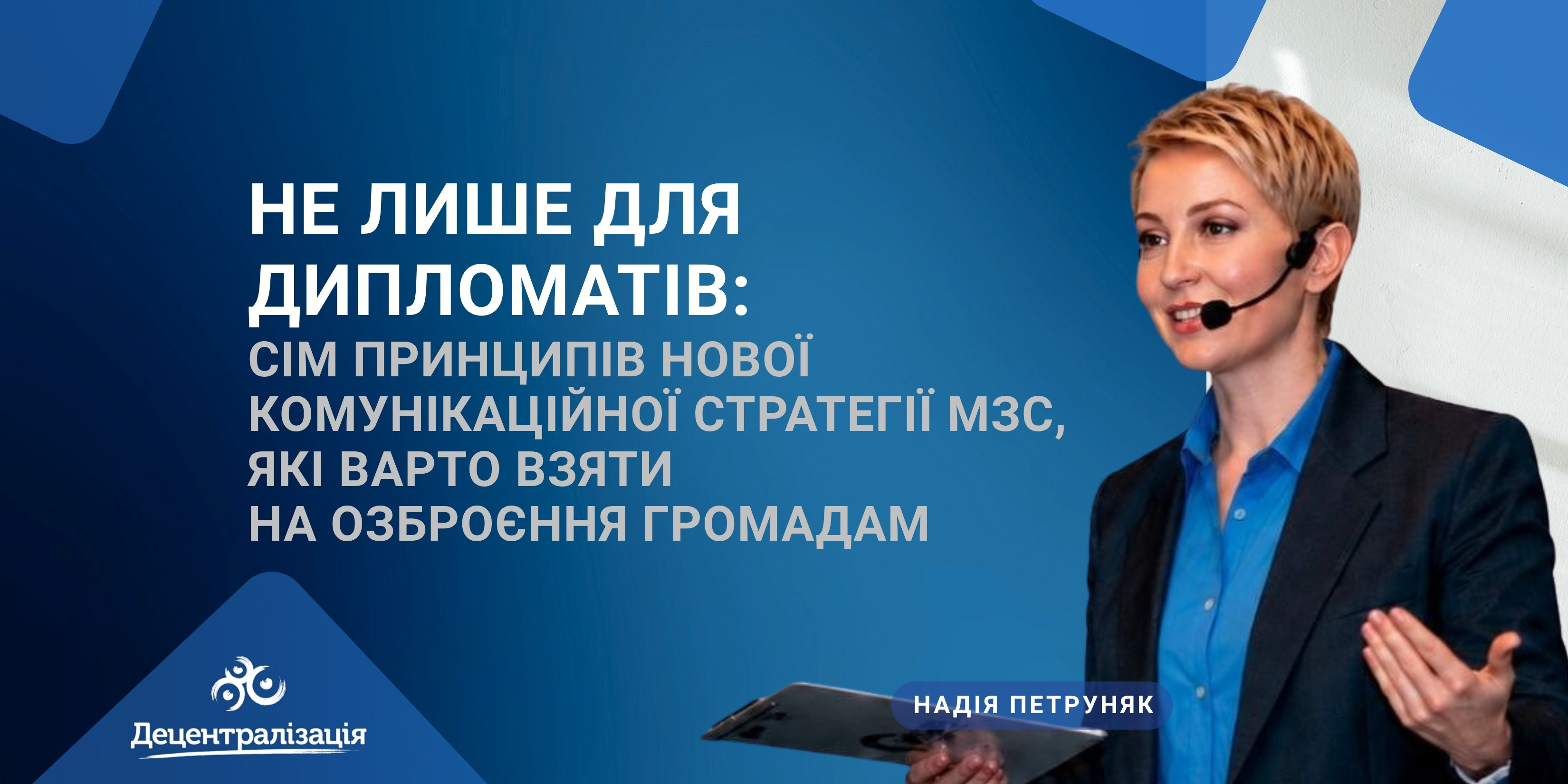
Not Just for Diplomats: Seven Principles of the Ministry of Foreign Affairs’ New Communication Strategy That Communities Should Adopt
International engagement by Ukrainian communities has changed dramatically in recent years
Whereas it was once largely confined to protocol visits and twinning agreements, today Ukrainian municipalities actively seek partners for recovery, present investment projects, work with international organisations, participate in European programmes, host foreign delegations, and engage directly with politicians, foundations, municipalities and media outlets abroad.
Each of these interactions shapes perceptions not only of a particular town or village. Through a local community, foreign partners see Ukraine itself – its institutional capacity, standards of governance, openness, reliability and ability to honour its commitments.
This is precisely why the Ukrainian Ministry of Foreign Affairs' new Communication Strategy for 2026–2030 deserves the attention not only of diplomats. The Strategy does not assign specific responsibilities to local authorities, nor does it introduce new mechanisms to support their international activities. Nevertheless, it sets out a number of approaches that can prove valuable for municipalities already playing an active role in Ukraine's international communications.
The Strategy proceeds from the understanding that communication is an instrument of public policy and a means of achieving foreign policy objectives. Its functions include advocating Ukrainian initiatives, safeguarding the country's reputation, promoting a positive image of Ukraine, countering disinformation, and shaping lasting perceptions among international audiences.
For local communities, this presents an opportunity to view their international engagement from a broader perspective – not simply as a way of securing resources for local development, but as an integral part of representing Ukraine to the world.
Communication should deliver results
One of the Strategy's central messages is that communication should not merely conclude a process – it should help make that process successful.
"The Ministry of Foreign Affairs regards communication not simply as reporting on work that has already been done, but as an integral component of diplomatic efforts."
This principle is particularly relevant for municipalities developing international partnerships. Publishing a press release after signing a memorandum, sharing photographs with a visiting delegation, or announcing the receipt of donated equipment records an event, but these actions alone do little to deepen cooperation.
Strategic communication begins much earlier. It starts with understanding why a municipality needs a particular partner, what value it can offer in return, which arguments are likely to be persuasive, and what outcomes the engagement is expected to achieve. Communication then accompanies the partnership throughout its entire lifecycle – from the initial contact and introduction of the municipality to the implementation of joint projects and the explanation of their results to both local residents and international audiences.
This represents a fundamentally different approach from the traditional practice of simply publicising completed activities. Within this model, communications professionals do far more than package decisions that have already been made; they help shape proposals that are meaningful, relevant and compelling for specific international partners.
Every message needs a clear structure
To develop communication products, the Ministry has introduced the MASK framework, based on four key questions: Mission, Audience, Signal and Context.
Mission defines the purpose of the communication. Audience identifies who it is intended for. Signal clarifies the core message that needs to be conveyed. Context considers how that message is likely to be interpreted within the recipient's political, cultural and social environment. According to the Strategy, this framework enables organisations to use communication resources more effectively, achieve measurable objectives and avoid common mistakes.
For local authorities, MASK can serve as a practical checklist before any international letter, presentation or publication reaches its intended audience.
Take, for example, a message about a school destroyed during the war. Its content should vary depending on its purpose. When informing local residents, the priority is to explain the condition of the building and outline the next steps. However, when addressing a potential international partner, the communication should go beyond describing the damage. It should present the number of children affected, demonstrate that a reconstruction project has already been prepared, explain the municipality's own contribution, outline the expected impact, and identify the role a partner could play.
Simply translating a local news story into English does not automatically make it effective international communication. Different audiences often require an entirely different structure, carefully selected arguments, and explanations of issues that may seem self-evident within Ukraine but unfamiliar to readers abroad.
The position of a supplicant does not create an equal partnership
One of the Strategy's strongest messages concerns how Ukraine should be perceived internationally:
"Ukraine should be seen not as a victim or a country that merely asks for assistance, but as a reliable and strong security partner—a country that offers solutions rather than problems."
For Ukrainian municipalities, particularly those severely affected by the war, the need for external support remains immense and entirely legitimate. Yet the way those needs are communicated largely determines the nature of future relationships.
Communication centred solely on shortages, destruction and unmet needs reinforces the image of a municipality as merely a recipient of aid. A genuine partnership, by contrast, is built on clearly defining the problem, presenting a well-prepared solution, demonstrating the municipality's own contribution, showing institutional capacity, and explaining the mutual benefits of cooperation.
A municipality can offer an international partner far more than the opportunity to finance a particular project. It can provide a testing ground for innovative technologies, share practical experience of operating under wartime conditions, develop joint educational or cultural initiatives, or foster cooperation between local businesses, educational institutions and civil society organisations.
This fundamentally changes the nature of the relationship. Instead of a one-off act of charity, it becomes a partnership in which both sides have a long-term interest.
Reputation is built through sustained communication
The Strategy rejects the pursuit of short-lived publicity. It argues that isolated messages quickly disappear in today's overcrowded information environment, making communication effective only when it is consistent, repeated and sustained over time.
For municipalities engaged internationally, this means that one successful speech at a conference or a single project presentation is not enough. Foreign partners assess a municipality through the cumulative experience of working with it: whether it communicates consistently, responds promptly to correspondence, reports on the implementation of agreements, provides reliable information, and maintains relationships long after a project has formally concluded.
Public reputation develops in much the same way. If a municipality communicates only when agreements are signed, but never reports on the outcomes, its international engagement can appear largely ceremonial. By contrast, when communication traces the entire journey—from the initial agreement to tangible improvements in people's lives—the partnership acquires a clear and credible narrative.
Consistency is particularly important for smaller municipalities that lack substantial communications budgets or dedicated international affairs departments. Their greatest competitive advantage may not be visibility, but reliability: a clearly defined profile, a limited number of strategic priorities, and the steady demonstration of their capacity through tangible results.
Understand your international audience rather than imagining it
The Strategy emphasises that external communication cannot follow a one-size-fits-all approach. Messages should take into account the language, imagery, cultural, historical, religious and political characteristics of each target audience.
For municipalities, this requires much more than translating materials into foreign languages.
The same proposal may need to be framed very differently for a neighbouring municipality in Poland, a German federal state, a Scandinavian foundation or a Japanese development agency. Some partners may prioritise inter-municipal solidarity; others will be more interested in technological innovation and measurable outcomes; still others may focus on economic potential, environmental standards or citizen engagement.
An effective municipality does not begin an international conversation with a lengthy presentation about itself. Instead, it starts by seeking to understand its counterpart – their priorities, previous experience, political and social context, opportunities and constraints.
Such preparation demonstrates respect for the partner while significantly reducing the risk that a well-designed local project will go unnoticed simply because it has been presented in the wrong way.
Ukraine's international voice is made up of many voices
A dedicated section of the Strategy focuses on building a broader communications community around the Ministry of Foreign Affairs. The document explicitly recognises that modern foreign policy communication cannot rely solely on the resources of the diplomatic service. It must also involve state and non-state actors, expert communities and civil society.
One passage is particularly noteworthy:
"The community operates as a distributed network, in which every participant reinforces the national narrative. Communication decentralisation amplifies the Ministry's efforts and strengthens the trust of international target audiences."
In this context, communication decentralisation does not refer to Ukraine's local government reform. Rather, it describes a distributed model of communication in which a wide range of actors reinforce the country's overall international message.
Territorial communities are a natural part of this architecture. They can present Ukraine to international partners beyond official government statements – through the work of local institutions, the decisions they have taken during wartime, the relationship between local authorities and residents, the development of local businesses, and the rebuilding of schools, hospitals, water supply systems and energy infrastructure.
Such communication carries particular credibility because it is grounded in first-hand experience. A Ukrainian mayor addressing the municipal council of a foreign city, a joint project between two schools, or professional cooperation between municipal utility companies can build trust at a level that national communication campaigns cannot always achieve.
At the same time, a distributed communications model does not imply fragmented or contradictory messaging. The Strategy calls for coordination of external communications, the exchange of information, and alignment of positions, including with local authorities. This is especially important when municipalities communicate about security issues, the consequences of missile attacks, international negotiations, sensitive statistical data or topics that could be exploited by Russian propaganda.
Communication should be measured by outcomes, not outputs
The Strategy advocates moving away from intuitive assessments of communication towards measurable performance indicators. Among the possible metrics it identifies are audience reach, media citations, sentiment analysis and shifts in public attitudes. More importantly, however, it offers a broader principle:
"The Ministry of Foreign Affairs treats communication as an exact science, where success is measured not by the number of activities undertaken, but by tangible shifts in public opinion and the achievement of concrete agreements and decisions."
For local communities, this may be one of the Strategy's most valuable lessons.
The number of news releases, meetings, memoranda signed or overseas visits says very little about the effectiveness of international engagement in itself. What matters far more is whether an initial contact develops into a long-term partnership; whether a foreign municipality supports a specific project; whether new opportunities emerge for local businesses, young people, educational institutions or municipal service providers.
The same principle applies to communication itself. Did international partners understand the municipality's proposal? Did it change their perception of the community? Did new organisations make contact after a publication appeared? Were existing partners persuaded to continue their cooperation? Has the municipality established a reputation in a particular field – such as energy efficiency, education, social policy, digital transformation or post-war recovery?
Evaluating communication in this way requires municipalities to plan their communications alongside the project itself and define in advance the specific change that communication is intended to achieve.
From international relations to municipal diplomacy
The Ministry's Communication Strategy does not formally recognise Ukrainian territorial communities as independent actors within the country's diplomatic system. It would therefore be an exaggeration to claim that the document officially assigns them a new diplomatic role.
Nevertheless, the Strategy clearly reflects a broader transformation. Ukraine's international communication is no longer concentrated within a single government institution, nor is it confined to formal diplomatic channels. Instead, it is evolving into a network of interconnected voices capable of communicating Ukraine's positions to diverse audiences and building long-term international trust.
Ukrainian municipalities are already operating within this new reality. They conclude international agreements, participate in European networks, present recovery projects, engage directly with municipal leaders abroad, and increasingly shape how Ukraine is perceived internationally.
The next step is to do so consciously: to understand the purpose of every international engagement; to research the target audience; to offer partners solutions rather than simply requests; to build trust systematically over time; to coordinate communication on sensitive issues; and to evaluate success by real-world outcomes rather than communication outputs.
Only then do a municipality's international links cease to be a collection of isolated projects and gradually evolve into municipal diplomacy—professional, strategic and capable of advancing both local development and Ukraine's international standing simultaneously.
The column reflects solely the position of its author. The author of the column is responsible for the accuracy of the information. The viewpoint of the editorial team of the ‘Decentralization’ portal may not coincide with the viewpoint of the column’s author

28 July 2026
PFRU оголошує набір на другу хвилю Школи для громад «Культура у відновленні»
PFRU оголошує набір на другу хвилю Школи для...
Програма «Партнерство за сильну Україну» (PFRU) оголосила набір проєктних команд прифронтових громад на другу хвилю...
28 July 2026
Invitation to Hromadas for Partnership in Strengthening the Starosta Institution
Invitation to Hromadas for Partnership in...
The Swedish-Ukrainian Polaris Programme ‘Support for Multilevel Governance in Ukraine’ (2024–2028), that is funded by...
27 July 2026
Vacancy: Project Coordinator for Local Implementation Support
Vacancy: Project Coordinator for Local...
Description of the context To address the changing needs of Ukrainian municipalities and national level...
27 July 2026
UCORD підготував посібник з кадрової політики для агенцій регіонального розвитку
UCORD підготував посібник з кадрової політики...
Як побудувати сучасну систему управління персоналом в агенції регіонального розвитку? Як організувати прозорий добір...