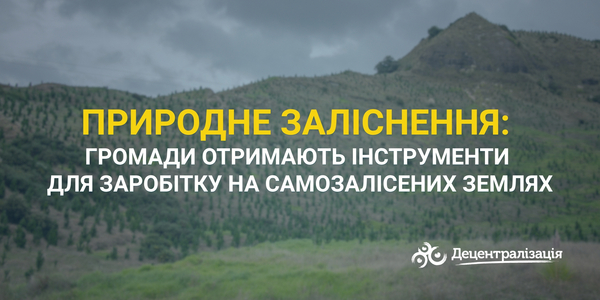
Natural afforestation: Communities to receive tools to generate income from naturally forested land
In Ukraine, 1.9 million hectares of such land have been identified, but bureaucratic obstacles are hindering their use. A seminar attended by representatives from the Ministry of Economy, the Ministry of Environment and the Ministry of Agriculture was held to discuss how communities can participate in the process.
Local self-government can gain a new source of revenue and create jobs through the proper management of naturally forested land. However, the current mechanisms for transferring these plots to the forest fund are excessively complicated. This topic was the subject of a professional seminar organised as part of the World Bank’s EU4Environment Project.
To date, approximately 1.9 million hectares of naturally afforested land have been identified in Ukraine. However, only a small proportion of these have been approved and transferred for use. The transfer process remains slow due to complex procedures and an imperfect regulatory framework.
The seminar brought together representatives of state authorities, relevant institutions, experts and, importantly, representatives of pilot communities. The main aim was to develop practical solutions for advancing this initiative at the local level.
According to Taras Vysotskyi, Deputy Minister of Economy, Environment and Agriculture of Ukraine, the issue of managing naturally afforested lands combines ecology, social issues, and the economy:
‘This involves both protecting the environment and creating new opportunities for community growth, such as jobs and additional revenue for local budgets. It is essential to establish a clear and supportive legal framework, as well as effective cooperation between all institutions, from state authorities to communities.’
Communities play a key role in decision-making on the conservation, use, and development of such lands. This creates additional opportunities for:
- economic growth;
- the creation of new jobs;
- increased revenue for local budgets.
During the seminar, modern approaches were discussed, in particular the use of carbon credits. These are special certificates for CO₂ absorption, which a community or forest user can sell to companies to offset their emissions. This mechanism significantly increases the economic appeal of afforestation and can become an additional source of income for local governments.
The participants concluded that the current legislation already provides a certain framework but requires improvement, taking into account the practical experience of communities. It is necessary to:
- simplify the procedures for transferring land to the forest fund;
- introduce clear mechanisms of accountability;
- create incentive tools for communities.
Following the seminar, proposals from participants are to be summarised for the further improvement of legislation and management models. This should accelerate the integration of naturally forested land into the forest fund and strengthen the role of communities in the development of the forestry sector in Ukraine.
For reference: the event was organised as part of the World Bank’s EU4Environment Project.
Source:
Портал "Децентралізація"
13 May 2026
Як ЄС підтримує громади в Україні: можливості Ukraine Facility
Як ЄС підтримує громади в Україні: можливості...
Ключовим механізмом підтримки відновлення, реконструкції та модернізації України Європейським Союзом є Механізм...
12 May 2026
Динаміка фінансової спроможності територіальних...
Автори: Яніна Казюк, доктор наук з державного управління, професор, експерт з публічних фінансів та місцевого...
12 May 2026
Фатальні кредити або Як громада захищає своїх підприємців
Фатальні кредити або Як громада захищає своїх...
Від редакції Ми публікуємо цей матеріал, бо він про річ, яку не виміряєш статистикою: довіру. Довіру людей до...
11 May 2026
Committee recommends that Parliament adopt...
The Verkhovna Rada Committee on the Organisation of State Power, Local Self-Government, Regional Development and...