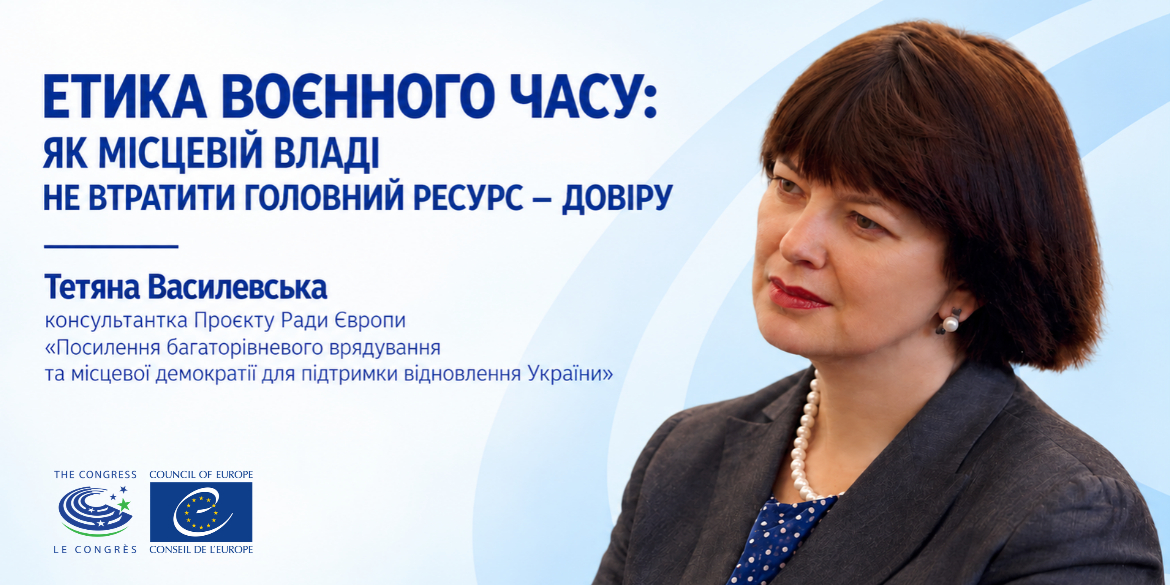
Ethics in wartime: How local authorities can keep their most important resource – trust
Imagine a typical morning in a community that, like the rest of the country, lives under martial law. Local authorities face a cruel dilemma: where should the remaining budget funds be allocated first? Should they repair the hospital roof damaged by shelling, purchase generators for critical infrastructure, or restore the destroyed water supply system in a residential neighbourhood? Each of these needs is a matter of survival. But there is only enough money for one of them.
There is no time for public consultations or lengthy discussions – decisions have to be made immediately. In this situation, any choice will satisfy only one group of residents, leaving others to face their problems alone. This will inevitably lead to discontent.
This is the reality in which Ukrainian local self-government operates today – in a context where people’s lives and well-being depend directly on every signature on a document.
When practicality conflicts with morality
The war has changed not only the scale of the challenges, but also the very nature of decision-making. Every decision has become a complex moral choice. It forces decision-makers to ask themselves again and again: is this fair? Will people understand this? Is this the only correct course of action in this situation?
Therefore, ethics today is not a philosophy detached from real life, but a thoroughly practical tool for everyday management.
In times of war, local governments operate under immense pressure. There is the factor of urgency, a total shortage of material, financial and human resources, and a lack of complete information on the security or economic situation. Moreover, they often have to solve problems that no one has ever faced before. All this takes place under the watchful eye of residents, as the authorities’ actions have become critically important to them.
How should community leaders act in such circumstances so as not to lose their most valuable resource – the trust of residents? After all, trust is the foundation of unity, mutual support and, ultimately, survival during wartime.
If the authorities’ actions are unclear, non-transparent, or unfair, a rift begins to form in the community. People become disillusioned instantly, losing their sense of the leadership’s reliability and predictability. During wartime, society becomes hypersensitive to mistakes and insincerity.
Constant stress and the pressure of circumstances can give rise to a dangerous illusion in the decision-making chambers: namely, that since swift action is required now, transparency can be disregarded, decisions can be made behind closed doors, and everything can be attributed to “wartime expediency”. However, officials often forget that such backroom dealings undermine the credibility of the authorities and damage their reputation, which will take years to rebuild.
Five guiding principles for ethical decision-making
For a decision taken by the authorities to support development rather than undermine the community, it requires clear ethical guidelines:
- Putting public interest first and acting with integrity. Decisions have to benefit the community, rather than serve the private interests of those in power or specific political or business groups.
- Humanity and respect for dignity. Decisions and communication with residents have to be based on respect for people and sensitivity to their interests and needs. Even if the authorities are forced to refuse assistance due to a lack of resources, this refusal has to be humane, rather than blunt or arrogant.
- Fairness and transparency. Material resources, benefits, or humanitarian aid have to be distributed fairly and proportionally, based on transparent criteria, taking into account the degree of vulnerability rather than the personal sympathies of those in charge.
- Rational and moral justification. The authorities are obliged to openly explain their choices, along with the moral and rational criteria behind them. What options were considered? Why was this particular one chosen? Why did the others have to be rejected?
- Willingness to take responsibility. Officials have to take honest responsibility for the consequences of their actions, be able to acknowledge and correct mistakes, and compensate for the negative effects of unsuccessful decisions.
This approach is also in line with Recommendation CM/Rec(2023)5 of the Committee of Ministers of the Council of Europe on the principles of good democratic governance. It emphasises the importance of integrity, transparency, accountability, and a focus on the public interest in the work of public institutions. In times of crisis, these principles serve as practical guidelines for the daily decisions of local authorities.
The role of a leader and organisational culture
In times of uncertainty, society expects leaders to possess particular qualities. Today’s leader is someone who is capable of minimising the negative effects of war, enhancing community resilience, applying innovative approaches and establishing effective communication both inside their team and with the public. Commitment to the public good, empathy, a keen sense of justice and moral responsibility are basic requirements for a leader, not merely added bonuses.
Moreover, a leader sets the standard for behaviour across the entire leadership hierarchy. If a mayor allows themselves to make non-transparent, biased decisions, the team may perceive this as a “green light” for similar actions at their own levels.
The opposite is also true: if a leader fosters a safe ethical environment in the team, subordinates will not be afraid to openly discuss complex dilemmas even before decisions are made and documents are signed. They will be able to ask the leader difficult questions and highlight the ethical risks of proposed decisions, which significantly reduces the risk of managerial errors. An organisational culture that respects every employee’s opinion and is responsive to citizens’ concerns enables the team to function as a single, effective unit.
Possible scenarios: How it works in practice
To understand exactly how ethical principles preserve trust, compare the opposing approaches in typical situations.
Situation 1: Distribution of limited aid (e.g. generators)
- Unethical approach: Allocating scarce equipment to large commercial enterprises or “friends” without any public explanation, guided by considerations of cronyism. The result is an immediate erosion of the authorities’ credibility and the potential for social unrest.
- Ethical approach: Setting up a commission with the participation of the public and volunteers. Publicly announcing a clear order of priority: first, we supply operating theatres in hospitals; then, water supply pumping stations; followed by invincibility points. A reasoned and honest dialogue with residents minimises the possibility of any speculation.
Situation 2: Repairing an administrative building after shelling
- Unethical approach: Allocating significant funds to repair offices, hiding the tender behind a simplified wartime procedure. Responding to public outrage with a formalistic statement: ‘The authorities need the conditions to work; everything is legal’. This is a sure-fire recipe for a high-profile media scandal and a loss of legitimacy in the eyes of the public.
- Ethical approach: Redirecting budget funds to critical needs – setting up protective shelters or purchasing alternative energy sources for the community. If, however, the damage to the Administrative Services Centre or the city council is critical and paralyses the provision of services to the public, the authorities have to present the community with specific figures and calculations. It is necessary to explain clearly: ‘Repairs to this building are essential so that you can obtain certificates, apply for benefits, and restore documents.’ Only then will this action be perceived as being in the public interest.
In lieu of conclusions
The foundation of any power relationship in a democratic society is public trust. For everyone involved in local self-government, gaining and maintaining this trust is a key task. Strengthening trust in local governments creates the conditions for Ukraine’s democratic development, whereas establishing integrity in the authorities’ activities fosters a favourable environment for life.
During wartime, trust in local authorities is a matter of national security and the resilience of our home front. It is not determined solely by dry figures of the final outcome. The community assesses the entire process: how a decision was discussed, how honestly the authorities spoke about the difficulties and possible consequences, and whether the authorities treated every resident fairly throughout. Adherence to ethical principles in times of crisis is a vital way to maintain public support and stand firm together.
The views expressed in this publication are solely those of the author and may not reflect the official policy of the Council of Europe.
The column reflects the opinion of its author only. The author is responsible for ensuring the accuracy of the information. The views expressed in the column may not coincide with those of the editorial staff of the Decentralisation Portal.

04 November 2026
Primary healthcare reform to be rated on 64 indicators: What will be assessed
Primary healthcare reform to be rated on 64...
The Ministry of Health of Ukraine presented a methodology for a comprehensive study of the outcomes of the primary...
04 November 2026
Міжнародні молодіжні та дитячі обміни | П’ятниця з Cities4Cities
Міжнародні молодіжні та дитячі обміни |...
Молодіжні та дитячі обміни – один із найпоширеніших форматів для старту міжнародного муніципального партнерства. 6...
03 November 2026
From housing strategy to practical solutions:...
Housing policy in wartime has to address several challenges simultaneously: helping people find accommodation,...
03 November 2026
A national park within a municipality or a...
National nature parks in Ukraine comprise millions of hectares of forests, water bodies and protected ecosystems. Yet...