EU Cohesion Policy: Ukraine needs not only laws, but a system of governance and partnership
For Ukraine to participate in the European Union’s cohesion policy, simply changing individual laws is not enough. A comprehensive system needs to be established: development programmes, a portfolio of operations, co-financing mechanisms, institutions for management, monitoring and control, as well as an ongoing partnership between the state, regions, communities, business, and civil society.
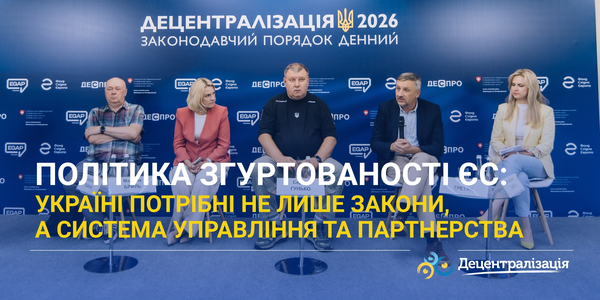
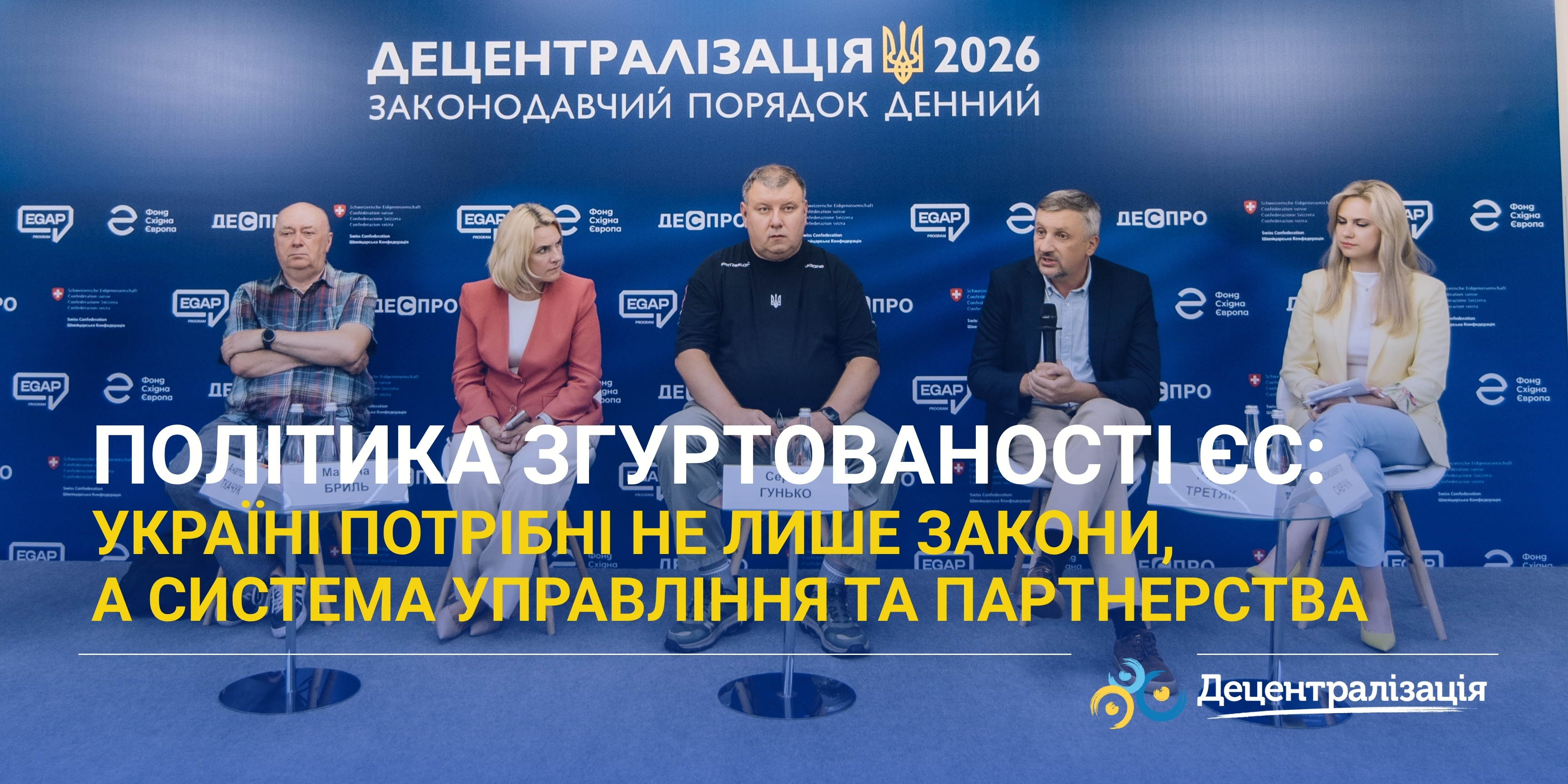
This topic was discussed during the “Decentralisation 2026. Legislative Agenda”. Yurii Tretiak, an expert with the U-LEAD with Europe programme, and Maryna Bryl, the Swiss-Ukrainian “Ukraine’s Cohesion and Regional Development” (UCORD) Project Lead, shared their views on this.
Cohesion policy – an investment mechanism for the development of territories
Yurii Tretiak reminded that Ukraine had been shaping its state regional policy for many years, drawing on the experience of European countries and EU recommendations. The legislative framework, he said, is based on planning, funding, implementation, monitoring and institutions. However, funding has long remained its weakest link.
‘We have a very good system, enshrined in the Law on the Principles of State Regional Policy. But at different times, things have not worked out, and most importantly, funding has not worked out. The 1% of the State Fund of Regional Development was never allocated, and it was difficult to coordinate the efforts of different sectoral ministries to implement the State Strategy of Regional Development.’
In his view, Ukraine’s status as a candidate country for EU accession provides an opportunity for the country to prepare for full participation in cohesion policy. The policy aims to support less developed regions, reduce development disparities and transform the economy, infrastructure, energy sector, mobility and people’s living environments through investment.
‘Above all, cohesion policy is an investment policy. It enables new Member States to transform different sectors in regions and territories, thereby boosting the development of the country as a whole as communities are developed.’
Eight conditions and a master plan for Chapter 22
Yurii Tretiak stated that the European Commission has already set out the preconditions for Ukraine, against which it will assess the country’s readiness to close negotiation Chapter 22, which concerns regional policy and the coordination of structural mechanisms.
Key tasks include demonstrating the effective use of existing EU instruments, particularly the Ukraine Facility and Interreg; establishing a framework for cohesion policy programmes; preparing a strategic document and a portfolio of operations and co-financing mechanisms; and setting up institutions to manage, control the finances, audit, monitor, and evaluate.
‘Implementing the conditions of Chapter 22 is not just about legislation. Above all, it is about establishing a system for jointly managing cohesion policy and the European Union’s structural and investment funds.’
The expert reported that a team of Ukrainian and international specialists, including representatives from U-LEAD with Europe and the relevant Ministry, has already prepared a draft master plan to fulfil the conditions of Chapter 22. The document has been submitted to the negotiating team and the new ministry, but it requires further refinement, verification and implementation.
‘This document sets out what needs to be changed. For each of the conditions, there are detailed measures, tasks and designated responsible parties. The master plan should become the new Ministry’s handbook.’
Yurii Tretiak says that work on the master plan should be coordinated by an interdepartmental commission on regional development. Although such a commission has already been set up, he says its activities need to be stepped up in order to fulfil the objectives of Chapter 22.
Partnership is not a formality, but a rule for the development of programmes
The expert paid special attention to the principle of partnership, one of the cornerstones of EU cohesion policy. Programmes funded by the Structural Funds should not be drawn up by the Ministry or regional authorities alone.
According to European rules, local governments, businesses, universities, civil society organisations and socio-economic partners must be involved in developing and implementing them.
‘Such documents and programmes must be developed jointly, on the basis of partnership, by different stakeholders. It is not the Ministry nor the regional administration that independently approves the programme under which project competition will take place. Monitoring committees are set up for this purpose – these are extremely important bodies, and we still need to learn how to work with them.’
U-LEAD with Europe has already delivered training for regional military administrations and regional development agencies on the fundamentals of cohesion policy and project management. The next stage is set to involve practical support for eight pilot regions in developing strategies, establishing monitoring committees and project management bodies, as well as financial management and control systems.
Clear roles and stable funding for institutions
Maryna Bril, the Swiss-Ukrainian UCORD Project Lead, emphasised that before deciding on legislative changes, Ukraine has to agree on exactly what kind of regional development system it wishes to establish and which institutions will be responsible for its operation.
‘Before we start thinking about what legislation we need, we need to understand what sort of regional development system we want to build and what this system requires.’
She said that public investment, strategic planning, restoration, and digital systems must be coordinated with one another. UCORD, in particular, searched the DREAM platform for projects of regional significance for potential funding, but it proved difficult to find a sufficient number of such projects.
Therefore, the regions need strong institutions capable of preparing sustainable projects, managing them, and bringing together the different participants in regional development around common priorities.
‘I would single out three things: accountability, clearly defined institutional roles, and stable, predictable funding. The roles of regional development agencies need to be defined more clearly, as they are currently somewhat vague in the legislation.’
She stated that, in the future system for managing European projects, regional military administrations could act as an intermediary body. In that case, regional development agencies could play a supporting role: bringing together stakeholders, analysing the situation in the region, helping to set priorities, and preparing projects.
However, if the agencies themselves were to become the intermediary bodies, the law would need to define their functions, as well as the control and monitoring mechanisms.
From strategy to economic projects
Maryna Bryl argues that regional policy should place far greater emphasis on economic development. Within the framework of UCORD, initiatives are implemented in creative industries, the development of manufacturing capacity, and support for entrepreneurs and their exports.
‘Economic initiatives should be interconnected and, at the same time, based on regional strategies. This is the direct route to developing projects that will align with regional priorities and will subsequently be eligible for funding from regional or donor budgets.’
As an example, she referred to Volyn region, which, as part of a cluster development initiative, secured a USD 5 million World Bank grant to develop the region’s cluster potential.
The participants in the discussion agree that Ukraine’s readiness for cohesion policy will not be measured by the number of documents adopted. It will depend on whether the state can establish a unified management system, train professional teams, ensure predictable funding, and involve regions and communities in shaping development programmes.
Read more about the general legislative agenda in the article “Delineation of powers, community resources and rules for frontline territories: Legislative agenda of decentralisation”.
Read more about the findings of a survey of community leaders in the article “Remuneration, personal income tax, and legitimacy of councils: What community leaders named as legislative priorities”.
Read more about the staffing capacity of communities, administrative services, and the legislation on administrative fees in the article “Administrative Service Centres start with people: What communities need for quality administrative services”.
Read more about the powers of local councils, military administrations and special rules for frontline territories in the article “How to retain the legitimacy of local councils during wartime and regulate the functioning of frontline communities”.
Read more about the involvement of local government associations in law-making and their proposals for strengthening the resource base of communities in the article “Local government associations: Draft laws to be developed with communities, and resources to remain locally”.
Read more about Anatolii Tkachuk’s approaches to reforming the system of planning and financing regional development in the article “Four steps to effective regional policy: Anatolii Tkachuk’s approaches”.
Source:
Портал "Децентралізація"
22 September 2026
Capacity building and empowerment of local communities in Ukraine
Capacity building and empowerment of local...
This article of the U-LEAD series identifies the additional and strengthened capacities that Ukrainian local...
22 September 2026
Polaris Programme Selects 13 Rural Hromadas for Cooperation to Strengthen the Starosta Institution
Polaris Programme Selects 13 Rural Hromadas for...
Following the Open Call, 13 rural hromadas from 8 oblasts of Ukraine were selected for cooperation with the...
22 September 2026
Жити містом, а не долати його. Як безбар’єрний...
Безбар’єрність міського простору починається з конкретних рішень, які дають людям більше самостійності у щоденному...
22 September 2026
Tender: Support to preparation of Development...
The Polaris Programme: Support to Multi-Level Governance in Ukraine invites eligible tenderers to submit...