The EU integration of Ukraine’s regions: Why is EU accession negotiation in Chapter 22 the most difficult?


Ukraine is moving confidently along the path of European integration. The screening process of Ukrainian and EU legislation has been completed, negotiating positions are being prepared, and reforms, despite the war, are continuing. But among the 36 negotiating chapters, there is one that creates a dangerous illusion. Chapter 22, “Regional policy and coordination of structural instruments,” does not require Ukraine only to transpose EU directives into national legislation. At first glance, this may make it seem like a simple negotiation chapter. In reality, it is one of the most difficult ones.
The reason is that Chapter 22 is about systems, institutions, and capacities. The EU acquis under this chapter consists primarily of framework and implementing regulations that set the rules for the programming, approval, and implementation of EU Cohesion Policy programmes. These programmes are negotiated with the European Commission, but their implementation is the full responsibility of the EU Member State. In other words, the EU will not ask Ukraine whether it adopted the right law; the EU will ask: is Ukraine capable of managing billions from the European taxpayers´ funds?
And this question is not rhetorical. The EU Cohesion Policy accounts for nearly one-third of the entire EU budget: around €392 billion in the 2021-2027 period. After accession, under the current methodology for allocating EU Cohesion Policy funding, virtually all regions of Ukraine would qualify as “less developed” (with GDP per capita significantly below 75% of the EU average), opening access to potentially tens of billions of euros in investment. But without a functioning Management and Control System (MCS), no funding will flow. The European Commission’s assessment in its annual Enlargement Reports throughout 2023-2025 has remained unchanged: Ukraine has “some level of preparation” and has shown only “limited progress” under Chapter 22.
Institutional system: who is responsible for regional development in Ukraine?
The first thing an external observer notices when analysing Ukraine’s institutional landscape in the field of regional policy is its complexity and fragmentation.
At the national level, responsibility is dispersed across several actors around a so-called “centre of governance”.
The Ministry responsible for Development of Communities and Territories is the main line ministry that shapes state regional policy and administers the State Fund for Regional Development (SFRD). At the same time, the Ministry of Economy serves as the National Coordinator of the Ukraine Plan and therefore controls the public investment management (PIM) reform and a significant share of the broader investment agenda.
The State Agency for Restoration and Infrastructure Development, created in 2023, has become a key implementing body. Meanwhile, the Office of the President exerts significant influence on regional policy through the appointment of heads of regional administrations and through the initiation of new coordination structures, such as the National Recovery Council.
What is critical is that the Interagency Coordination Commission on Regional Development should bring all these actors to one table. The result is that the ministry shaping the investment framework is not the ministry responsible for regional policy. In some parts, there is competition of mandates.
At the regional level, the situation is even more complex.
Ukraine retains a dual governance system: appointed regional state (military) administrations function in parallel with elected regional councils. The head of the regional military administration, appointed by the President, and the head of the regional council, elected regionally, may often have different priorities. Regional administrations are both the drafters of regional strategies and the bodies responsible for monitoring their implementation — a classic conflict of interest, where the implementer evaluates itself. Councils formally approve strategies that were actually prepared by the administration.
Regional Development Agencies (RDAs), a potentially important operational instrument, are functioning in 22 out of 25 regions, but they need to be strangthened. Their financing is unstable, and their status is not always clear: they often find themselves in the middle of varying interests of their founders, namely the regional administration and the regional council.
This picture means one thing: at the regional level, Ukraine does not have a single legally empowered and administratively capable partner able to manage programmes, make project decisions, and bear responsibility for the funds. And this is precisely what the EU Cohesion Policy fund management system requires.
At the local level, 1,469 territorial communities created as a result of the decentralisation reform carry a significant burden of responsibility, from developing strategies to managing sectoral issues. But there is a mismatch between responsibilities and resources: although personal income tax forms the backbone of local budgets, many of the tasks delegated to communities are financed through earmarked subventions from the state budget, calculated on the basis of often outdated statistics. Moreover, the Enlargement Reports of the European Commission explicitly note that high staff turnover due to mobilisation, internal displacement, and migration remains a serious challenge for local authorities.
Strategy, space and recovery:
Why does planning not function as a single architecture?
A critical bottleneck in Ukraine’s preparation for Chapter 22 is its system of planning documents. As of today, it looks less like coherent architecture and more like layers of strategies, programmes, recovery plans, and spatial planning documents that exist in parallel at the national, regional, and local levels. In practice, this means not only a large volume of paperwork, but also an unclear hierarchy, overlapping functions, and weak links between documents that should operate as a single system.
This is of fundamental importance. EU Cohesion Policy does not operate through abstract declarations, but through a clear logic: strategic priorities must be linked to territory, financing instruments, and real projects. That is why, for Ukraine, the issue is not creating yet another document, but rather streamlining the entire system so that strategic, spatial, and recovery planning no longer exist as separate worlds, but instead become parts of one process.
Financial architecture: between the tactics of recovery and the strategy of development
The main national financing instrument for regional policy, the State Fund for Regional Development (SFRD), illustrates all the contradictions of the system. Its operations were suspended in 2022, with resources redirected to defense. In 2025, the SFRD was reactivated, but on a small scale: UAH 1 billion, equal to only around 0.05% of general fund revenues of the state budget.
There have been positive shifts. The 2025 relaunch brought important modernizations: integration with DREAM (the digital ecosystem for restoration management), alignment with the public investment management (PIM) reform, and a new national commission for selecting investment projects, which now includes representatives of local self-government associations and civil society organisations. This is a direct step toward implementing the partnership principle of the EU Cohesion Policy. The previous model was also abolished, under which members of the Verkhovna Rada Budget Committee held at least 50% of the seats on the commission, an arrangement criticised for its potential conflict of interest.
However, the fundamental contradiction remains unresolved: the SFRD is caught between its original mission of long-term strategic development and its new recovery mandate. Initially created as an instrument for financing the priorities of the State Regional Development Strategy (SRDS), it has now been reoriented toward recovery projects. This creates a risk: funding is directed toward visible “patching of holes” (rebuilding destroyed infrastructure) at the expense of less visible but strategically important investments in regional competitiveness.
The broader financial architecture of regional development also does little to enhance predictability. Subventions, the main mechanism for financing delegated responsibilities, are often tied to outdated calculations. The municipal debt market remains underdeveloped: historically, fewer than 2% of municipalities have participated as borrowers. Despite encouraging steps, such as the restoration of medium-term budget planning at the local level in 2024 and the planned increase in SFRD financing to UAH 90 billion for 2026-2028, the system still lacks what matters most: stability, predictability, and strategic focus.
The partnership principle: formality in place of dialogue
EU Cohesion Policy is built on the partnership principle, enshrined in the European Code of Conduct on Partnership (ECCP). This means the mandatory, active, and meaningful involvement of stakeholders (public authorities at all levels, businesses, trade unions, civil society, and academic institutions) at every stage of the policy cycle: from preparing strategies and selecting projects to monitoring their implementation. This is not a recommendation; it is a legal requirement.
In Ukraine, reality stands in sharp contrast to this standard. Stakeholder engagement remains largely episodic and formalistic. Public participation is most often channeled through temporary working or advisory groups rather than through permanent, empowered institutions. Businesses and academic institutions report that their role is generally limited to consultations rather than genuine, systematic participation in decision-making.
This problem is institutional in nature. The key Law “On Public Consultations” has been adopted but has never entered into force; its implementation has been frozen until the end of martial law. For some newer documents, including recovery and development plans for territorial communities, public consultations are not even legally mandatory.
As a result, implementation of the partnership principle remains a fundamental cultural and governance shift that Ukraine has not yet made. Without institutionalising partnership, which ensures that stakeholders have not only a voice, but a voice with weight, any system for managing EU funds will remain a merely formal shell.
Time to act: the questions Ukraine must ask itself now
The analysis conducted by the EasyBusiness team with the support of the U-LEAD with Europe Programme leaves no room for illusions. In order to absorb EU funds (and this is not a matter of some abstract future, but of very concrete institutional preparation already today), Ukraine must move from a fragmented system to a coherent institutional architecture. Poland’s experience shows that this is possible: a strong central ministry that does not centralize implementation but enables it at the regional level, a gradual build-up of regional capacity through an incremental approach, and ultimately the transfer of responsibility for managing a significant share of Cohesion Policy funds to the regional level.
At the same time, this article does not seek to provide final answers. Its purpose is to initiate a dialogue. But even now, Ukraine faces fundamental dilemmas that no single actor in regional development policy can resolve on its own:
1. How can national responsibility for regional policy be consolidated? Is it possible to create a single institutional centre, similar to the Polish model, where responsibility is concentrated in one ministry coordinating both strategy and negotiations with the EU?
2. What should the SFRD be: a budget programme or a separate agency? Should Ukraine transform its main instrument for financing regional development into an independent legal entity, and what would be the advantages and risks of each option?
3. What should be the optimal role of Regional Development Agencies at the pre-accession stage? How can they be given a stable mandate and financing while resolving the conflict between their founders?
4. How can the governance duality at the regional level be overcome? Who should become the single capable and accountable regional partner for managing development programmes: a self-government body or a deconcentrated state authority?
5. How can the partnership principle be institutionalized? Are advisory groups enough, or does Ukraine need permanent monitoring committees with real powers, as required by the EU Cohesion Policy?
6. How can recovery and development be balanced? Should a separate temporary recovery fund be established in order to protect the strategic mission of the SFRD?
And most importantly: the Ukraine Facility and its first and largest pillar, the Ukraine Plan, are our “training ground” right now. The audit, reporting, and conditional disbursement system that Ukraine is already building under the Ukraine Plan is a direct analogue of the institutional culture that will be needed to manage EU Cohesion Policy funds. But so far, this system remains centralized, without involving regional and local levels in management and oversight.
A dialogue that cannot be postponed
Institutional capacity in the field of Chapter 22 depends not so much on formally prescribed procedures as on practical knowledge acquired through “learning by doing.” The systems and personnel needed to manage billions of EU funds will not appear overnight. They must be built now, project by project, institution by institution, decision by decision.
And it is all of us who must carry forward this dialogue and this work: the government, the parliament, regions, communities, business, and civil society.
Materials for this article were prepared by NGO “Easy Business” within the project “Supporting Regional Engagement in Ukraine’s EU Accession Process”, supported by U-LEAD with Europe. Its implementation lasted from July 2025 to March 2026 with the main goal to support Ministry for Communities and Territories Development of Ukraine in meeting the recommendations of the European Commission under Ukraine Enlargement Reports concerning Chapter 22 Regional Policy and Coordination of Structural Instruments.
U-LEAD with Europe: Local Empowerment, Accountability and Development Programme is a multi-donor action of the EU and its member states Germany, Denmark, France, Austria, Poland and Slovenia to support Ukraine on its path to strengthening local self-government. U-LEAD promotes transparent, accountable, resilient and responsive multi-level governance in Ukraine and empowers municipalities.
The contents of this article are the sole responsibility of its authors and do not necessarily represent the views of U-LEAD with Europe, the European Union and its member states Germany, Denmark, France, Austria, Poland and Slovenia.
***
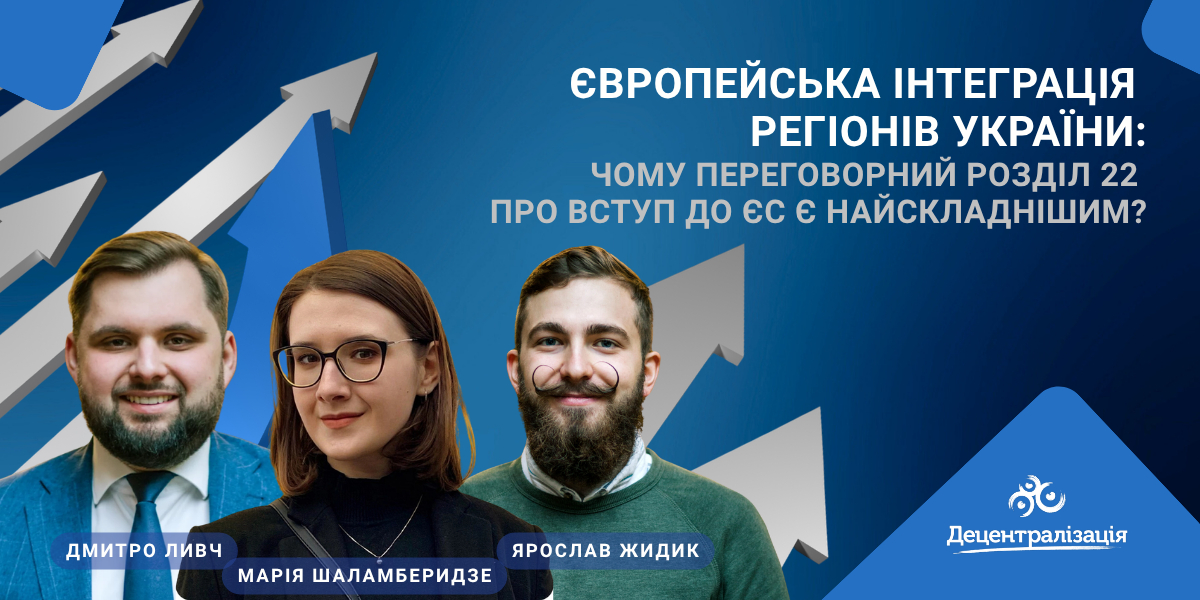
Dmytro Lyvch is Managing Partner for Public Sector Advisory at Civitta Ukraine and Chair of the Board and CEO of EasyBusiness, a leading free-market think tank in Ukraine. An economist with more than ten years of experience, he specializes in evidence-based policymaking, structural economic reforms, and regional development, having led the Odesa Region Recovery and Development Strategy and coordinated the development of Ukraine’s National Economic Strategy 2030. Within U-LEAD with Europe Phase III, he serves as a national expert on planning and programming systems and enabling conditions, supporting the development of Ukraine’s Chapter 22 Master Plan. Dmytro completed Harvard Kennedy School’s Executive Education program “Leading Economic Growth” and is currently a PhD candidate in International Economics at Taras Shevchenko National University of Kyiv.
Yaroslav Zhydyk is Associate Partner at Civitta and Head of the Regional Development Division at EasyBusiness. With more than seven years of experience in consulting, public policy, and economic analysis, he specializes in regional and local economic development and strategic planning. He coordinated the regional development and entrepreneurship sections of Ukraine’s National Economic Strategy 2030 and authored publications on growth poles and the use of EU regional policy instruments. Within U-LEAD with Europe Phase III, he serves as a national expert on institutional framework and administrative capacity, supporting the development of Ukraine’s Chapter 22 Master Plan and regional capacity building. Yaroslav holds a master’s degree in Entrepreneurship, Trade and Stock Exchange from Taras Shevchenko National University of Kyiv, where he is currently a PhD student.
Mariia Shalamberidze is a Senior Analyst in the EU Integration streams of Civitta and EasyBusiness. She specializes in Ukraine’s European integration, focusing on the EU accession process, institutional capacity assessment, and policy analysis. She has authored analytical reports on the EU enlargement process and on the procedural and political bottlenecks of Ukraine’s accession, and provided analytical support to the Government Office for the Coordination of European and Euro-Atlantic Integration. Mariia holds a master’s degree in Private International Law from the Institute of International Relations of Taras Shevchenko National University of Kyiv.

26 August 2026
Віталій Безгін: інтеграція ВПО потребує сталих житлових рішень і комплексного підходу
Віталій Безгін: інтеграція ВПО потребує сталих...
Інтеграція внутрішньо переміщених осіб у нових громадах потребує комплексного підходу, за якого житло поєднується з...
26 August 2026
АІКОМ 2: відповідаємо на найпоширеніші запитання
АІКОМ 2: відповідаємо на найпоширеніші запитання
Експерти Швейцарсько-українського проєкту DECIDE відповіли на поширені запитання щодо роботи в системі АІКОМ...
26 August 2026
У Києві відбувся Шостий Саміт перших леді та джентльменів
У Києві відбувся Шостий Саміт перших леді та...
У Києві відбувся Шостий Summit of First Ladies and Gentlemen, започаткований першою леді України Оленою Зеленською....
26 August 2026
Regional Development Policy in Austria
Regional Development Policy in Austria
SUMMARY Austria’s regional and spatial policy has undergone a fundamental transformation over the past five...