Most rules of European AI Act came into force: what this means for local self-government
On 2 August 2026, most of the provisions of the EU Artificial Intelligence Act came into force in the European Union. This is the world’s first comprehensive legislative framework for AI. It sets out rules for the developers, sellers, and users of such systems, including local governments.
The AI Act was adopted in 2024. It is based on a risk-based approach: the greater the impact a technology may have on human rights and society, the stricter the requirements for its use.
For EU municipalities, this applies to AI solutions in social protection, housing programmes, education, employment, infrastructure management, and the provision of administrative services.
For example, systems involved in the distribution of social assistance, the assessment of housing applicants, or the preparation of administrative decisions may be classified as high-risk. In such cases, it is not enough simply to purchase or launch a service. Local authorities are required to ensure human oversight of the functioning of such systems, maintain documentation and system logs, assess the potential impact on citizens’ fundamental rights, manage risks, and monitor data quality.
At the same time, certain practices involving the use of AI are prohibited in the EU. These include, in particular, the social ranking of citizens, the use of emotion recognition systems in the workplace, and most instances of real-time biometric identification in public spaces.
The law also requires transparency. People must have the understanding that they are communicating not with a city council employee but with a chatbot, or that they are receiving a message generated by artificial intelligence.
Local authorities have long since moved beyond simply using electronic queues or online applications. Communities use digital tools for data analysis, internal operations, communication with residents, and service delivery. Generative AI has added to this the preparation of documents, the processing of large volumes of information, the creation of texts, and initial responses to residents’ enquiries.
Technology is developing faster than the habit of checking exactly how it affects people. Therefore, for municipalities, the question is no longer simply whether to use AI. More importantly, it is about where it genuinely helps, who is responsible for its decisions, and whether residents have the opportunity to understand and dispute them.
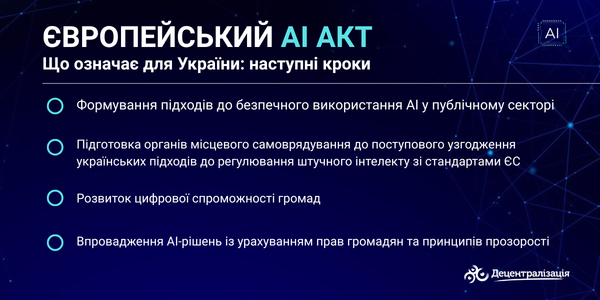
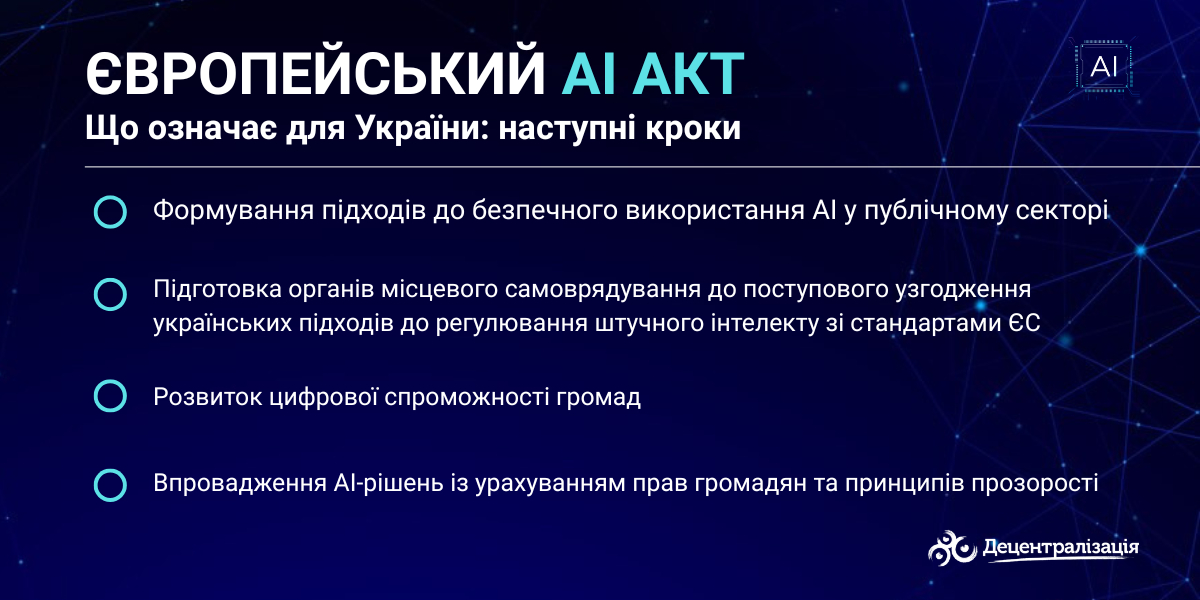
Ukraine is not a member of the EU, so the EU AI Act does not apply to it directly. However, in the process of European integration, this document should be viewed as a guide. Ukrainian communities that are developing digital services can already incorporate clear rules, the protection of citizens’ rights, and transparency into their work with AI.
This is not about rejecting new technologies. It is about ensuring that, in the public sector, artificial intelligence does not become yet another non-transparent system whose decisions cannot be explained.
Source:
Портал "Децентралізація"
24 August 2026
Про відновлення. Українська проблема та французький досвід
Про відновлення. Українська проблема та...
Замість вступу Війна триває, проте питання відновлення/відбудови присутнє у порядку денному. Багато об’єктів...
21 August 2026
Анонс: вебінар «Шкільне харчування в громаді: від юридичного рішення до безпечної логістики»
Анонс: вебінар «Шкільне харчування в громаді:...
До участі запрошуємо керівників органів управління освітою, керівників закладів освіти та всіх, хто відповідає за...
21 August 2026
Vitalii Bezgin: Government approves draft law...
The Government approved a draft law that will regulate the status of employees of military administrations in...
20 August 2026
«Серпнева-2026». Проєкт DECIDE традиційно виступив партнером головної події року в освіті
«Серпнева-2026». Проєкт DECIDE традиційно...
18 серпня у Києві відбулася щорічна освітня конференція «Серпнева–2026», яка цьогоріч пройшла під гаслом «Освіта —...