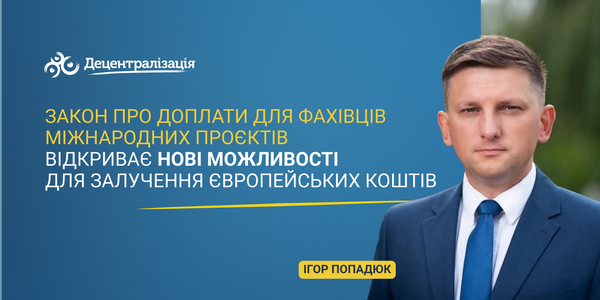
Law on additional payments for LG specialists involved in international projects opens up new opportunities to attract European funding – Ihor Popadiuk
Law No. 4887-IX, signed by the President of Ukraine, which regulates the material incentives for local government officials involved in the implementation of international technical assistance and international territorial cooperation programmes and projects, is set to be an important step towards strengthening the capacity of communities to work with international partners.
In order to understand how the new law will affect local governments, the Decentralisation Portal asked Ihor Popadiuk, Director of the Department of Investment Policy, Projects, International Relations, Tourism and Promotion at the Ivano-Frankivsk City Council, for his comments. Ivano-Frankivsk has long-standing experience in attracting international technical assistance and implementing international cooperation projects; therefore, its practical experience can help assess how the new law will affect the work of communities and what opportunities it opens up for local governments.
The law that communities waited for many years
According to Ihor Popadiuk, the newly adopted law finally resolves one of the most pressing issues that has for years hampered the implementation of international projects in Ukraine – the legislative regulation of remuneration for local government employees who work in project teams.
‘This Law addresses one of the many key issues related to the attraction and implementation of international projects in Ukraine, namely the remuneration of specialists (teams) for the implementation of international projects in compliance with the budgetary expenditure of the relevant projects.
This matter is not merely a pressing one; in my view, it has required an urgent solution over the past few years. We first encountered this challenge back in 2017 whilst preparing to implement the URBforDAN project as part of the first wave of the Danube Transnational Programme. Such projects are primarily aimed to facilitate the exchange of experience between partners on addressing common challenges in the Danube region; thus, a significant portion of their budget consists of salaries for local government employees. However, all beneficiaries found that the necessary legislation for the disbursement of these funds did not exist.’
A similar situation, he notes, arose during the implementation of the Interreg 2014–2020 cross-border cooperation programmes – Romania–Ukraine, Poland–Belarus–Ukraine and Hungary–Slovakia–Romania–Ukraine.
Although local government employees prepared the project applications, won the tenders, and were responsible for implementing the projects, they were unable to officially receive the funding provided for by the programmes to do this work.
As a result, explains Ihor Popadiuk, each community was forced to find a way out of the situation on its own.
‘Every local government, as well as international programmes, looked for different mechanisms to resolve this issue at their own discretion – they hired specialists under civil law contracts, used the services of individual entrepreneurs, and appointed inspectors to oversee project implementation. This greatly complicated the implementation of international projects, because such employees were not local government officials.’
According to Ihor Popadiuk, the problem remained unresolved even after the launch of the new Interreg NEXT 2021–2027 programming period.
‘Ukrainian representatives in programme management bodies simply failed to take into account the problems of previous periods, so beneficiaries from Ukraine once again faced the same challenges in recruiting project employees, namely the inability to officially involve local government officials in international projects.
The Interreg Europe programme, in particular, highlighted this problem, with calls to participate in it coming from the very highest official quarters. However, the budget for this programme consists precisely of the salaries of beneficiaries’ staff, who in most cases are local government employees.’
Therefore, he is convinced that the adoption of Law No. 4887-IX virtually puts Ukrainian communities on an equal footing with municipalities of EU countries in terms of opportunities.
‘Given the practice of paying bonuses to local government officials in our European partner countries involved in international projects, the adoption of this law has virtually levelled the playing field between Ukrainian local governments and their EU counterparts in the competition for European funds.’
Incentives to stay and work in the community
According to Ihor Popadiuk, the new mechanism will serve not only as a financial incentive but also as a key factor in preserving professional staff in communities.
He explains: today, the preparation and implementation of international projects demand far more from staff than simply performing their routine duties. This involves additional knowledge, a high level of responsibility, continuous learning, liaising with donors, preparing reports, undergoing audits, and working to tight deadlines.
‘When a local government specialist realises that, by securing international funding, they will receive additional remuneration for implementing the project, this, on the one hand, motivates them to develop international cooperation, and on the other, to undertake further training and attract new funding from the EU and international funds, whilst remaining part of the local government team.
Employees will be able to see that their work on preparing and implementing an international project will be fairly remunerated from the project budget itself. They will then realise that their extra efforts, sense of responsibility, language skills, and work with donors, audits, reporting, and very strict deadlines are really appreciated.
This will also encourage employees to develop: to study EU programmes, improve their foreign language skills, work with international standards and regulations, and seek new opportunities for the community. And most importantly, people will remain in the community team rather than move to the private sector or international organisations, where wages are significantly higher.’
Source:
Портал "Децентралізація"
21 August 2026
Анонс: вебінар «Шкільне харчування в громаді: від юридичного рішення до безпечної логістики»
Анонс: вебінар «Шкільне харчування в громаді:...
До участі запрошуємо керівників органів управління освітою, керівників закладів освіти та всіх, хто відповідає за...
21 August 2026
Vitalii Bezgin: Government approves draft law...
The Government approved a draft law that will regulate the status of employees of military administrations in...
20 August 2026
«Серпнева-2026». Проєкт DECIDE традиційно виступив партнером головної події року в освіті
«Серпнева-2026». Проєкт DECIDE традиційно...
18 серпня у Києві відбулася щорічна освітня конференція «Серпнева–2026», яка цьогоріч пройшла під гаслом «Освіта —...
20 August 2026
Ключові зміни в організації інклюзивного навчання у 2026/2027 н. р. за новим Порядком
Ключові зміни в організації інклюзивного...
ключові зміни у складанні індивідуальної програми розвитку (ІПР) та інших документів; особливості організації...