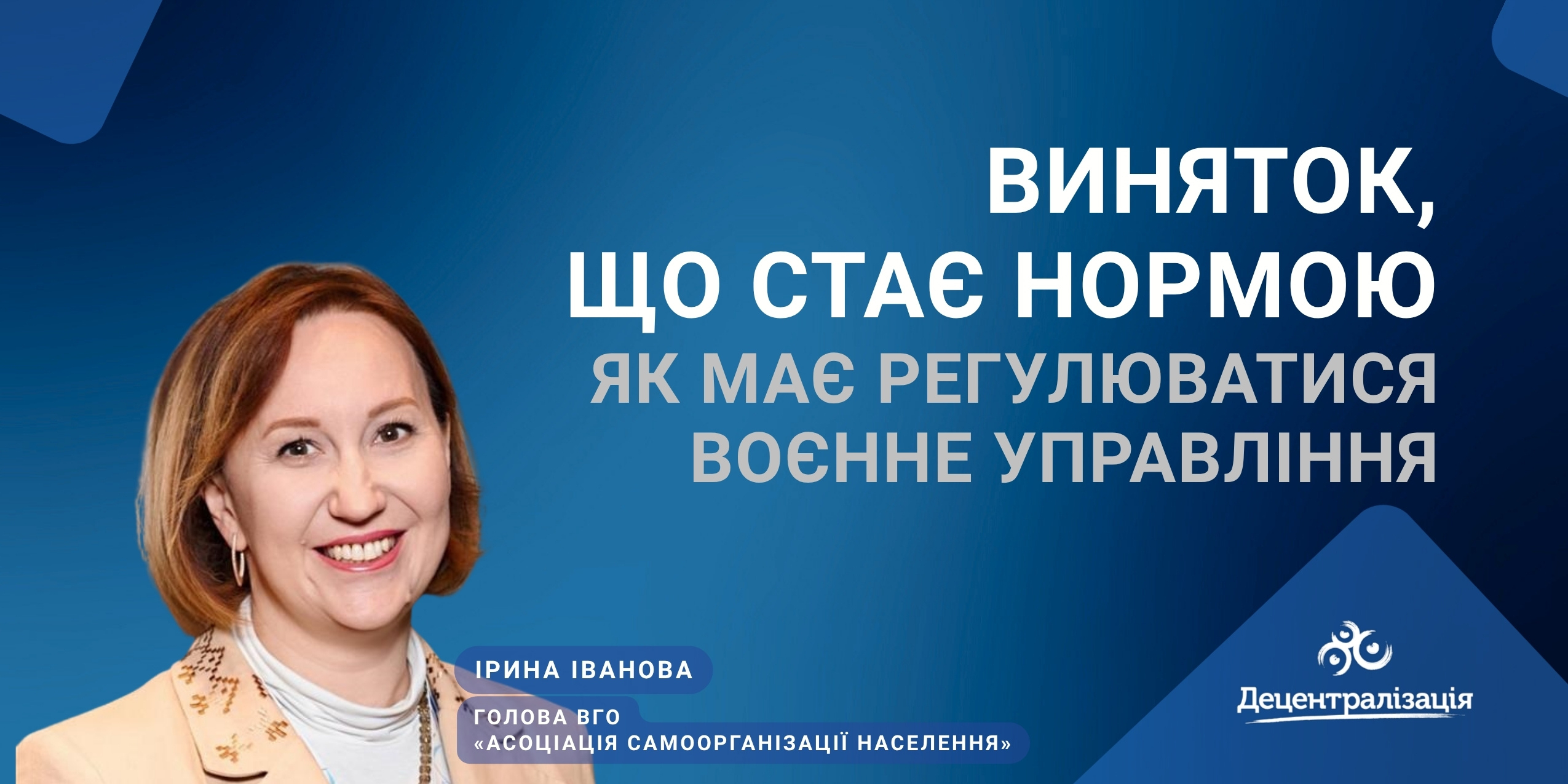
Exceptions that become the norm. How military governance should be regulated
Iryna Ivanova
Head of All-Ukrainian NGO “Association for Community Self-Organisation”
If an exception remains in place for long enough, it ceases to be an exception. It becomes the norm. This is exactly what is happening right now with the institution of military administrations in Ukraine, and there is no point beating about the bush.
When military administrations were introduced in localities in 2022, the logic was clear, as frontline communities had emerged where local governments were physically unable to function. They were set up as a last resort for extreme circumstances. But today, military administrations are operating in Varash, Netishyn, and Odesa. These are not frontline cities. There are formal grounds for their introduction, as the law allows for a fairly broad interpretation. But is this what this instrument was created for?
The European Commission explicitly states in its Roadmap that Ukraine must clarify the criteria for setting up military administrations in its legislation. The suspension of local self-government must remain a last resort, not a substitute for security decisions, particularly in territories far from the front line. This is not an abstract recommendation. It is a warning about a trend.
For three years in a row, the Association for Community Self-Organisation has been initiating wide-ranging expert discussions on these issues, and each such dialogue only confirms that democratic principles cannot be put on hold, even in wartime. We recently brought together experts, community representatives, and local government specialists once again to seek answers together. For the question is not whether there should be discussion, but whether we will manage to lay down the right standards before the exception becomes the norm.
The biggest flaw, which is rarely discussed in public, is the lack of a mechanism for the return of powers. The system currently operates in one direction only, because whilst there is a procedure for setting up military administration, there is no procedure for returning powers to the community. No one has defined what constitutes a ‘stabilised situation’, nor who is to determine this and by what procedure. Communities may remain without self-government for years, even when there are no longer any security grounds for this.
A separate problem arises in the so-called ‘dual system’, where both a council and a military administration operate in parallel within a single community. This is not a power-sharing arrangement. It is competition for those powers, with blurred responsibilities and reduced administrative efficiency. The decision here is fundamental, because if the Verkhovna Rada, upon the President’s proposal, adopts a decision to expand the powers of the military administration, it must fully assume the functions of the council, the executive committee, and the mayor. Then at least it will be clear who is responsible for what.
There is another silent collapse taking place without much fanfare. In communities with up to 10,000 voters – and there are quite a few of these – councillors were elected under a single-member constituency system in 2020. This means that in the event of a councillor’s term being terminated early, it is impossible to hold by-elections during martial law. The council gradually loses its membership, loses its quorum, and ceases to pass decisions. The community is left in a governance vacuum. The pragmatic solution under discussion is to allow such councils to make decisions based on their actual, rather than formal, membership. It is not an ideal arrangement. But it is the difference between a functioning community and anarchy.
Draft Law No. 14405 seeks to address precisely this problem. Its basic idea is worth supporting, but with important clarifications. The provisions should remain in force until new councils are elected in each specific community, rather than just for six months after the end of martial law. The transfer of powers from the council to the executive bodies should be clearly defined and apply only to those councils where elections were held under a single-member constituency system; it is precisely there that this problem of losing a quorum arises. There is no need to add another independent ground for setting up a military administration due to a lack of quorum. This ground is already covered by the general provision on the council’s failure to fulfil its powers.
All these details may seem technical, but in reality they point to much more important issues.
What is being enshrined in legislation now will determine what Ukraine will be like after its victory. If centralisation mechanisms are entrenched without clear criteria and without a way back, we risk ending up with a country with weak local self-government – not because someone decided it should be so, but because that is how things turned out, and no one established a mechanism for reversing the situation. A strong state is not only capable of centralising during a crisis, but also of decentralising afterwards.
‘We consistently support initiatives where civil society does not wait passively, but shapes its own vision of what legislative decisions should look like. This draft law addresses the realities of today’s martial law. We had hoped that martial law would end sooner, but today we must address the issues in the legislation, given its prolonged duration. We have already moved on to formulating specific solutions, and this was preceded by detailed work on the nuances of how the de-occupied territories function. The Foundation will continue to support this process, because it is precisely now that the legislative foundations of post-war Ukraine are being laid,’ notes Oleksii Orlovskyi, Director of the ‘Democracy and Good Governance’ Programme at the International Renaissance Foundation.
The answer to the question of what Ukraine will look like after the war is not to be found in the future. It is being shaped in the details of the draft laws being adopted right now.
This publication was prepared within the framework of the ‘Formulation of Conceptual and Legal Foundations for the Effective Post-War Recovery of Ukraine’s De-occupied Territories’ Project, supported by the International Renaissance Foundation.
The Project is implemented in cooperation with the All-Ukrainian NGO “Association for Community Self-Organisation Assistance”, NGO “Centre of Policy and Legal Reforms”, NGO “Civic Initiative of Luhansk Region”, and NGO “Association Revival and Development”.
This column reflects solely the views of its author. The author is responsible for the accuracy of the information. The views of the editorial board of the Decentralisation portal may not necessarily reflect those of the author.

01 May 2026
Відновлення, яке працює для людей
Відновлення, яке працює для людей
Команда проєкту U-RESTORE офіційно розпочала роботу з 12 відібраними громадами. 21–22 квітня відбувся дводенний...
01 May 2026
Дон Кіхот із Лозової. Інтерв’ю голови громади
Дон Кіхот із Лозової. Інтерв’ю голови громади
Голова Лозівської громади Харківської області Сергій Зеленський про те, як міська рада в умовах постійних обстрілів...
01 May 2026
Децентралізація – найголовніше за квітень
Децентралізація – найголовніше за квітень
На початку кожного місяця портал «Децентралізація» підбиває підсумки рішень Уряду та Парламенту, а також ключових...
30 April 2026
Ще понад 421 млн гривень отримають громади для...
25 закладів освіти отримають фінансування на придбання обладнання, створення та модернізацію харчоблоків. Уряд...