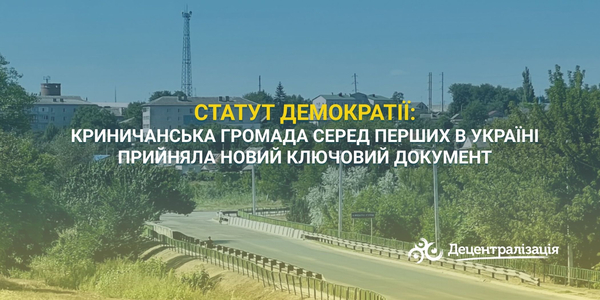
Charter of Democracy: Krynychky community among first in Ukraine to adopt new key document
Despite the difficult security situation, communities in the Dnipropetrovsk region are working towards building a sustainable future. Amid constant russian shelling and attacks on the region, the Krynychky community has taken a significant step towards strengthening its capabilities and developing local democracy.
On 19 December 2025, the main document of the Krynychky settlement community, the Krynychky Settlement Council Charter, was adopted at a plenary session of the council. It will come into force on 1 January 2026.
This event is particularly important as the Krynychky community is one of the first ten in Ukraine to approve the Charter based on updated recommendations from the Ministry of Development of Communities and Territories of Ukraine, as part of the Polaris Programme ‘Support for Multilevel Governance in Ukraine’. This demonstrates the community’s leadership in the decentralisation process, as well as its commitment to implementing the most modern European approaches to local self-government.
The decision to approve the Charter was made in line with the laws of Ukraine ‘On Local Self-Government in Ukraine’, ‘On Amendments to Certain Laws of Ukraine Regarding People’s Power at the Local Self-Government Level’, and the provisions of the European Charter of Local Self-Government.
A document developed jointly with the public
The process of developing the Charter was a striking example of genuine participation. The document was prepared over a long period of time through extensive public discussion, including public consultations, hearings and meetings with active residents, as well as the ongoing efforts of a designated working group. The final draft was approved by the relevant committee of the settlement council, thereby ensuring its legal validity and alignment with the community’s needs.
The main goal of the new Charter is to create real, convenient and effective conditions that enable every resident to participate in solving issues of local importance. It aims to strengthen public control and reduce bureaucratic barriers between the authorities and the people.
Key innovations and participation tools
The Charter introduces several progressive norms that broaden the range of participants in local life and the ways in which they can influence it:
- Integration of internally displaced persons (IDPs): IDPs are officially recognised as equal members of the community from the moment they register. This gives them the right to use all instruments of local democracy, including participation in the community budget.
- Youth empowerment: Young people are granted the right to initiate and participate in most forms of civic engagement from the age of 14. This is an unprecedented step towards involving the younger generation in community governance.
The document systematically regulates and expands the range of tools for direct democracy:
- General meetings (conferences) of residents for direct discussion and adoption of proposals to be considered by the council.
- Local initiative: the right of residents to submit draft decisions independently for the official consideration of the council.
- Public hearings with mandatory consideration of all proposals made.
- Electronic petitions (threshold – 100 signatures in 60 days), which guarantees consideration of the appeal.
- Participatory budgeting, which allows residents aged 16 and over to take part in allocating funds.
- School participatory budgeting, which gives schoolchildren aged 14 and over real experience in implementing their own initiatives.
- Advisory and consultative bodies (Youth Council, Council on IDP Issues, Barrier-Free Council).
- Public evaluation of the activities of local authorities.
- Citizens’ self-organisation bodies to represent the interests of residents at the level of a building or street.
- Board of trustees at municipal enterprises to ensure transparency.
- ‘Open City’ online platform for the prompt reporting of problems in the community.
A community that keeps developing despite challenges
The Krynychky community, located in the Kamianskyi district, is continuing to develop and improve the quality of life for its almost 9,000 residents, setting an example of resilience in its efforts to do so.
One of its most significant recent achievements has been the complete restoration of passport services in the community. Following the closure of the migration department in December 2023, these functions were taken over by the settlement council. With the help of the USAID Democratic Governance in Eastern Ukraine Project, the necessary equipment was obtained and, since 9 December 2024, residents have been able to apply for all types of passports at the Administrative Services Centre in Krynychky. This has greatly simplified life for people, especially the elderly and those with limited mobility.
Charter as the foundation for the future
The adoption of the Charter by the Krynychky community is a conscious, strategic step towards true local democracy. Given the ongoing aftermath of russian aggression in the region, the establishment of strong, transparent, and inclusive local governance institutions becomes even more important.
The new Charter establishes a social contract between the authorities and citizens, in which everyone has a voice, opportunities and responsibilities. It will provide a reliable legal foundation for the sustainable development of the community, attracting investment and improving service quality. Most importantly, it will strengthen people's belief in their ability to influence their own future. The Krynychky community demonstrates through its own experience that decentralisation and territorial development can produce tangible results even during challenging times.
Source:
Портал "Децентралізація"
26 December 2025
В Україні стартує проєкт «Будинки майбутнього: екологічне модульне житло»
В Україні стартує проєкт «Будинки майбутнього:...
Громадська організація ДЕСПРО долучається до проєкту державно-приватного партнерства «Будинки майбутнього: екологічне...
25 December 2025
«Більше, ніж місто: як Львів будує метрополію...
Автор: Дмитро Синяк Україна все ще будує власну модель децентралізації. Наступним логічним кроком після...
24 December 2025
Occupied but still standing strong Shulhynka. Interview with Head of Military Administration
Occupied but still standing strong Shulhynka....
Natalia Petrenko, Head of the Military Administration of the occupied Shulhynka rural community in the Luhansk...
23 December 2025
Швейцарська підтримка сприятиме реалізації...
5 агенцій регіонального розвитку отримають гранти на реалізацію стратегічних пріоритетів у рамках програми...