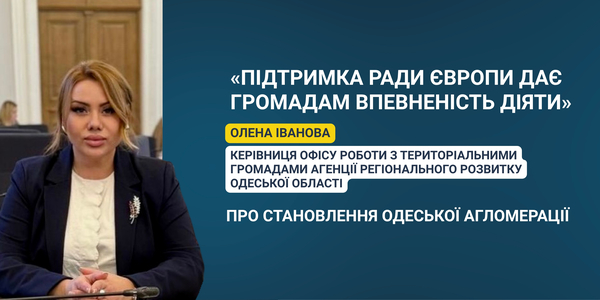
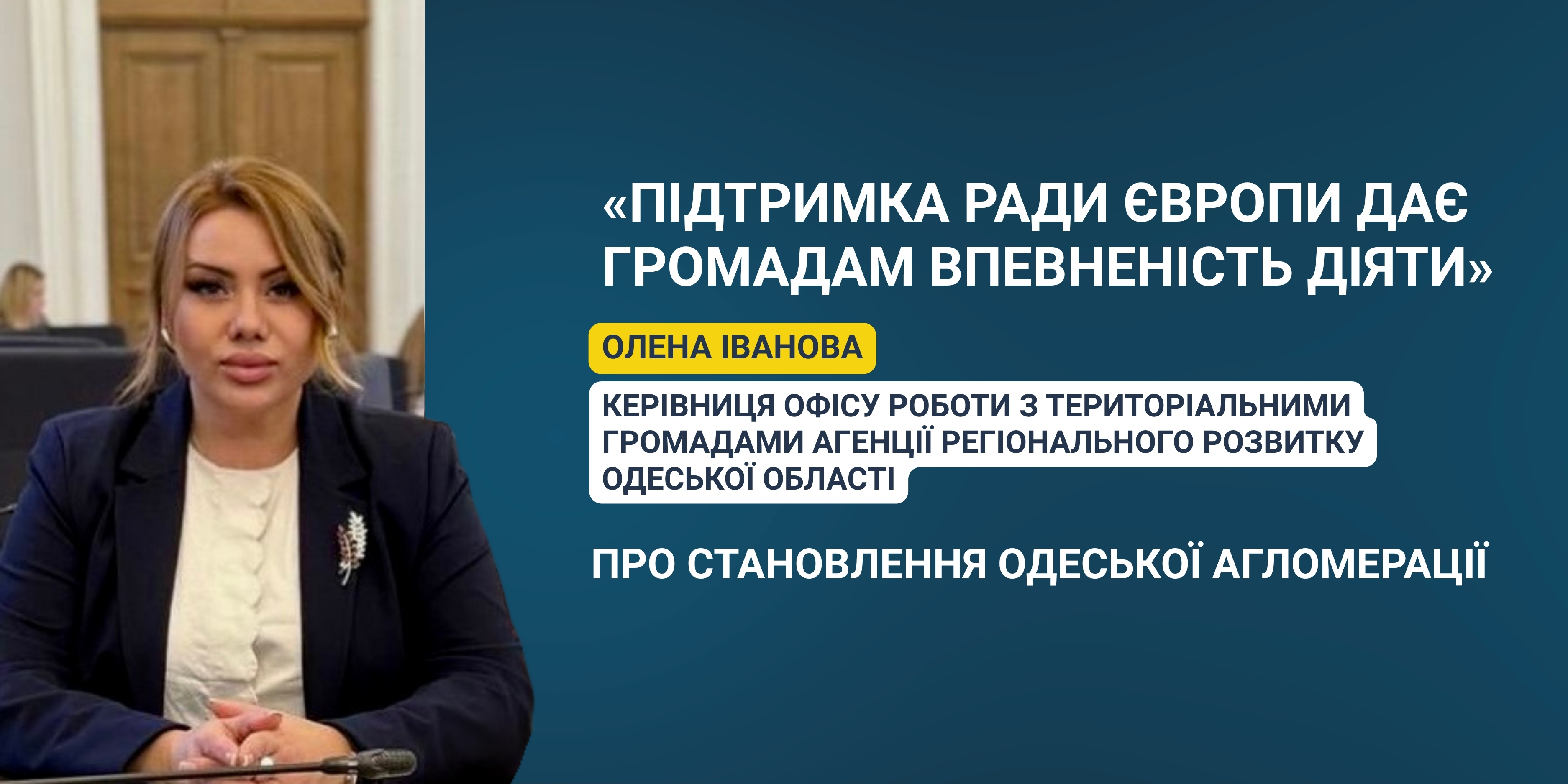
‘The support of the Council of Europe gives communities the confidence to act,’ – Olena Ivanova on the formation of the Odesa agglomeration
In October, representatives of communities from six regions of Ukraine, including from the Odesa region, took part in a peer-to-peer exchange visit to the Lviv region organised as part of the Council of Europe’s project ‘Strengthening multilevel governance and local democracy to support Ukraine’s recovery’ in cooperation with the Association of Local Authorities ‘Lviv Agglomeration’.
Olena Ivanova, Head of the Regional Development Agency of the Odesa Region’s Office for Work with Communities, shared her impressions of the visit and the prospects for creating the Odesa agglomeration, as well as the Council of Europe’s role in supporting these processes.
– Ms Olena, what prompted you to address the issue of agglomeration cooperation in the region?
– Agglomerations and metropolitan development are not just buzzwords; they are modern, effective tools for strengthening neighbouring communities. Agglomerations act as economic growth poles in different countries because they enable systematic, comprehensive and joint efforts to achieve set goals.
With the support of the Council of Europe, we conducted research into the prerequisites for establishing a potential Odesa agglomeration. This enabled us to reconsider how agglomeration cooperation could stimulate development in the Odesa subregion. Eighteen of the 22 communities located around Odesa confirmed their readiness to join the future agglomeration.
This is a very positive sign. Communities realise that by pooling their resources, they will be able to implement large regional projects that would be too ambitious for a single community to undertake alone. This is precisely where the strength of the agglomeration approach lies.
– You visited the Lviv agglomeration. What impression did that experience leave on you? What are your plans for creating the Odesa agglomeration in the future?
– The visit was very useful. We learned about the development strategy for the Lviv agglomeration and how to attract grant resources. We also saw how the metropolitan governance model works in Lviv, Zhovkva, and neighbouring communities, covering everything from transport project coordination to environmental issue resolution.
Our communities always focus on practical examples. Seeing that this is not just theory, but a real, functioning system, inspires us. Such visits motivate us to act faster, raise awareness, and convince us that we are on the right path.
Upon returning from Lviv, we intend to maintain communication with our communities, offering consultations and educational support. Our goal is to sign a memorandum of intent to establish the Odesa agglomeration. We will then continue to support communities in developing joint projects and concluding inter-municipal cooperation agreements. Seeing positive examples always works better: when communities see that someone else has succeeded, they want to join in too.
– On the second day of the visit, the Second International Forum of Agglomerations in Ukraine was held. Describe the event.
– The opportunity to learn how metropolises in Europe and the United States operate, and to discuss our ideas with colleagues from other regions, is a huge incentive. For Ukrainian communities, especially during wartime, it is important to feel that they are not alone and that they have the backing of the international community.
The Forum provided an opportunity to learn how modern metropolitan development models can be applied in Ukraine. We were presented with European standards of good metropolitan governance and successful practices for organising functional territories in EU countries. We also learned about models of metropolitan planning in the United States based on community partnerships and strategic coordination.
The Association ‘Lviv Agglomeration’ and the Council of Europe, who co-organised this Forum, have given us a sense of partnership and the confidence that we are moving in the right direction.
– What is the main conclusion you have drawn from this visit?
– The most important thing is realising that agglomerations can really work. When communities see a living example, it is more convincing than any document could be. Successful cases demonstrate the need for progress, which is precisely what we intend to achieve in the Odesa region. An agglomeration is not just a union of territories; it is a union of people and opportunities.
This material was produced within the Council of Europe Action Plan for Ukraine ‘Resilience, Recovery and Reconstruction’ for 2023–2026 and the project ‘Strengthening multilevel governance and local democracy to support Ukraine’s recovery’, implemented by the Centre of Expertise for Multilevel Governance at the Congress of Local and Regional Authorities of the Council of Europe.
Tags:
agglomeration exchange of experience
Область:
Одеська областьSource:
Програма Ради Європи
23 October 2026
Для представників громад Харківщини,...
Громадська організація Housing Institute запрошує представників територіальних громад Харківщини, Чернігівщини та...
23 October 2026
Мінрегіон та МОМ посилять підтримку ВПО: житлові рішення та підготовка громад до зими
Мінрегіон та МОМ посилять підтримку ВПО:...
Мінрегіон та МОМ оцінять потреби громад, які приймають переселенців, і визначать пріоритети для залучення додаткової...
23 October 2026
Доступні послуги для кожного: як Тростянецька громада виявляє та усуває бар’єри у ЦНАП
Доступні послуги для кожного: як Тростянецька...
Портал «Децентралізація» продовжує серію матеріалів про рішення громад, які роблять публічні послуги та простори...
23 October 2026
Олександр Корнієнко на Вінниччині обговорив фінансування громад і міжнародні програми
Олександр Корнієнко на Вінниччині обговорив...
Під час робочого візиту на Вінниччину Перший заступник Голови Верховної Ради України Олександр Корнієнко зустрівся з...