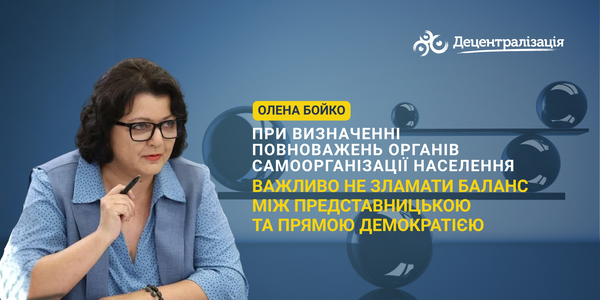
Olena Boiko: When defining the powers of self-organisation bodies, it is important to maintain the balance between representative and direct democracy
The Verkhovna Rada Committee on Organisation of State Power, Local Self-Government, Regional Development and Urban Planning is continuing to prepare for the second reading of Draft Law No. 6319 ‘On Amendments to the Law of Ukraine “On Self-organisation Bodies of the Population”, which aims to improve the organisation, activities, and termination procedures of self-organisation bodies of the population’.
Olena Boiko, an expert on local self-government, is a member of the working group responsible for drafting the document. She shared her vision for improving the legal regulation of the powers of self-organisation bodies.
‘Today, there is a lot of discussion about the distribution and delimitation of powers within the public administration system. I am talking about the powers of self-organisation bodies. This is the second most important issue for understanding the purpose of these bodies,’ notes the expert.
According to the expert, the current Law on self-organisation bodies divides their powers into two categories: their own powers and delegated powers. However, this division needs to be revised. The law mainly gives self-organisation bodies organisational functions, such as ‘representing’, ‘facilitating’, ‘making proposals’, ‘organising participation’ and ‘informing’. In other words, the expert argues that these bodies are ‘conditional assistant organisers’ with no authority.
There is only one control function: ensuring the quality of housing, utility services, and repair work in buildings. At the same time, the council may vest additional powers in the self-organisation body and transfer the relevant resources, provided they do not fall within the council’s exclusive competence.
‘The law stipulates that all the self-organisation body’s powers are transferred by the local council, including both ‘own’ and ‘delegated’ powers. Therefore, in essence, all of them are transferred,’ emphasises Olena Boiko.
‘Given the legal definition of ‘delegated powers’, using this term in relation to self-organisation bodies is incorrect. It is more accurate to speak of rights and transferred powers than of own or delegated powers.’
Olena Boiko also warns against the excessive expansion of the powers of self-organisation bodies, as this could destabilise the local self-government system.
In particular, the expert emphasises:
- Granting self-organisation bodies any control functions must be subject to clear definitions of the subject and limits of control, in order to avoid overlap with the powers of condominium associations.
- The transfer of powers that fall within the exclusive competence of local councils is unacceptable.
- Granting self-organisation bodies the functions of law enforcement agencies or those relating to national security is categorically unacceptable.
‘The philosophy of self-organisation bodies is that residents organise themselves to resolve issues of local importance. They are not a ‘forceful’ body, an authority or an independent entity within the public administration system. When defining the powers of these bodies, it is important to maintain the balance between representative and direct democracy,’ concluded Olena Boiko.
Source:
Портал "Децентралізація"
24 August 2026
Про відновлення. Українська проблема та французький досвід
Про відновлення. Українська проблема та...
Замість вступу Війна триває, проте питання відновлення/відбудови присутнє у порядку денному. Багато об’єктів...
21 August 2026
Анонс: вебінар «Шкільне харчування в громаді: від юридичного рішення до безпечної логістики»
Анонс: вебінар «Шкільне харчування в громаді:...
До участі запрошуємо керівників органів управління освітою, керівників закладів освіти та всіх, хто відповідає за...
21 August 2026
Vitalii Bezgin: Government approves draft law...
The Government approved a draft law that will regulate the status of employees of military administrations in...
20 August 2026
«Серпнева-2026». Проєкт DECIDE традиційно виступив партнером головної події року в освіті
«Серпнева-2026». Проєкт DECIDE традиційно...
18 серпня у Києві відбулася щорічна освітня конференція «Серпнева–2026», яка цьогоріч пройшла під гаслом «Освіта —...