Despite the war, 64 per cent of people in Ukraine still consider their locality to be safe
Despite ongoing russia’s attacks affecting almost all Ukrainian regions, the majority of Ukrainians consider their locality to be somewhat or completely safe. However, assessments vary significantly by region.
This is evidenced by the results of the eighth wave of the all-Ukrainian sociological survey ‘Multi-level governance in Ukraine in the context of a large-scale russian invasion’, which was conducted by the Kyiv International Institute of Sociology (KIIS) upon the request of the Council of Europe, as part of the ‘Strengthening Good Democratic Governance and Resilience in Ukraine’ Programme, in cooperation with the Verkhovna Rada Committee on the Organisation of State Power, Local Self-Government, Regional Development, and Urban Planning.
The study showed that 64 per cent of respondents considered their locality to be rather or completely safe, while 35 per cent considered it to be rather or very dangerous. This proportion increases significantly from west to east across the country: 16 per cent in the western regions, 32 per cent in the central regions, 51 per cent in the southern regions, and 61 per cent in the eastern regions.
Residents of larger towns and cities are more likely to feel unsafe. While 24 per cent of villagers said their area was unsafe, this figure rises to 44 per cent in cities with a population of 100,000 or more.
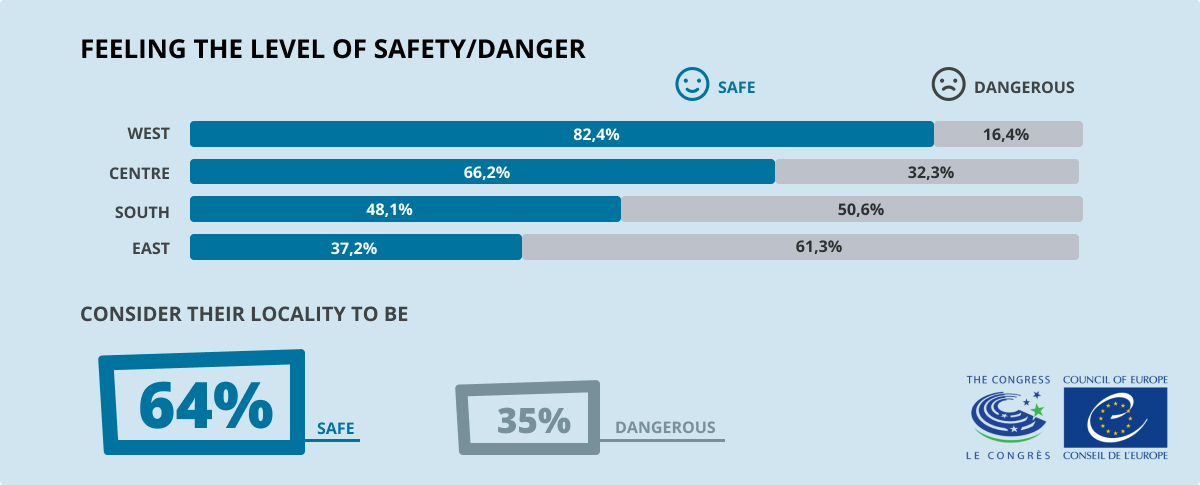
According to Anatolii Tkachuk, one of the authors of the study and a consultant to the Council of Europe, the study clearly demonstrated the existence of multiple macro-regions in Ukraine with regard to security:
- temporarily occupied territories;
- frontline regions (south-eastern and northern territories of Ukrainian regions close to the front line or the Ukrainian-russian border);
- macro-region centre;
- macro-region west.
‘Each of these macro-regions has its own particular characteristics with regard to living conditions, economic activity, and governance. These peculiarities should be taken into account when planning state policies and developing legislation related to the activities of local governments and their restoration,’ said Anatolii Tkachuk.
This division of macro-regions has not yet been reflected in legislation or other official documents. However, the Ministry for Development of Communities and Territories of Ukraine has already started using the terms ‘frontline community’ and ‘rear communities’ in its communications. In addition, the Government’s resolution on the introduction of the ‘Shoulder to Shoulder: Cohesive Communities’ project, uses the term ‘outpost communities’ to refer to those located less than 100 kilometres from the contact line and the russian border.
To view all the results of the eighth wave of the all-Ukrainian sociological survey ‘Multi-level governance in Ukraine in the context of large-scale russian invasion’, which was conducted in September-October 2024, please follow the LINK. The results of the previous survey, conducted in 2022, are available here.
01 August 2026
З прийняттям постанови Кабінету Міністрів України від 8 липня 2026 р. № 883 «Деякі питання державного фонду...
31 July 2026
BIM має стати єдиною системою управління інформацією про об'єкти будівництва
BIM має стати єдиною системою управління...
Заступниця міністра з відновлення, інфраструктури та транспорту України Наталія Козловська взяла участь в...
31 July 2026
Громади Європи: рішення місяця
Громади Європи: рішення місяця
липень 2026 Українські громади дедалі глибше входять у європейський політичний, правовий та професійний...
31 July 2026
Government allocates funding for 130 future academic lyceums to create modern educational spaces
Government allocates funding for 130 future...
Almost UAH 700 million will be allocated to 130 future academic lyceums in 22 regions of Ukraine – the Government has...